Pupil sheet · Lenses and images
Virtual images — questions
Name ______________________ Date ____________
Try every question before you use a nudge. Write in full sentences where you are asked to explain.
1. identify
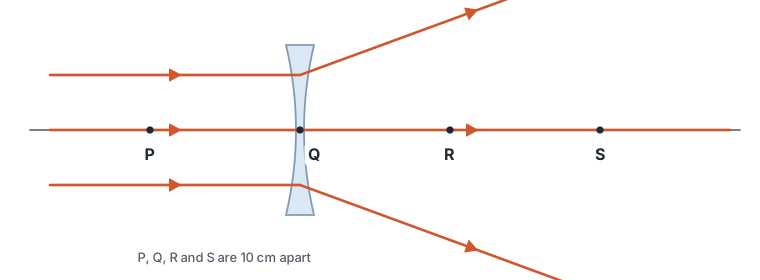
The diagram shows a parallel beam of light passing through a diverging lens. Four points, P, Q, R and S, are marked on the principal axis, 10 cm apart. Which point is the principal focus of the lens?
Circle one answer.
- P
- Q
- R
- S
Nudge (only if you are stuck): Continue the two spreading rays backwards in straight lines. Where do they meet?
2. predict
Through a converging lens, a pupil sees a small lamp upright and bigger than it really is. She then slides a white screen all along the bench on the far side of the lens. What does she find, and why?
Circle one answer.
- A sharp image far away, because spreading rays meet in the end.
- A sharp, upright image at one place, where all the rays meet.
- No sharp image: the lens stops the light reaching the screen.
- No sharp image anywhere: the rays never meet after the lens.
Nudge (only if you are stuck): An upright, bigger image through a converging lens: is the lamp closer to the lens than the principal focus, or further away?
3. identify
Is each image real or virtual?
Write the number of the matching option.
- Virtual
- Real
- The upside-down picture of a ceiling light that a magnifying glass throws onto a sheet of paper: ______
- A splinter in a finger, seen upright and bigger through the same magnifying glass held close to it: ______
- A goldfish seen bigger through the curved side of a round bowl of water: ______
- People outside seen small and upright through the diverging lens of a door’s spy-hole: ______
- A phone’s screen thrown sharp onto a wall by a lens in a shoebox: ______
Nudge (only if you are stuck): For each one, ask: do the rays really meet at the image, so that paper or a wall placed there would show it?
4. identify / explain
Two lenses, X and Y, look alike from the side. A pupil points each in turn at a lamp at the far end of a long hall and moves a white screen from 5 cm to 80 cm behind the lens. With X, the patch of light shrinks to a small, sharp spot and then grows again. With Y, the patch only grows. (a) Identify which lens is the diverging lens, and explain how the screen shows it. (b) The pupil says that Y has no principal focus, because its rays never meet. Explain why the pupil is wrong.
(a) The diverging lens, and how the screen shows it
(b) Why the pupil is wrong
Nudge (only if you are stuck): Which kind of lens can make the patch shrink? For (b), where do the rays leaving Y seem to come from?
5. describe / explain
Two pupils each see only a blurred patch of light on the screen behind a converging lens of focal length 12 cm. Pupil A’s lamp is 48 cm from the lens, and the screen is 12 cm from the lens. Pupil B’s lamp is 9 cm from an identical lens. (a) Describe what pupil A should do, and what A will find. (b) Describe what pupil B will find on the screen, and what B sees by looking through the lens. (c) Explain the difference between the two cases.
(a) What A should do and will find
(b) What B finds and sees
(c) The difference
Nudge (only if you are stuck): For each lamp, do the rays from one point meet after the lens, or not?
6. identify
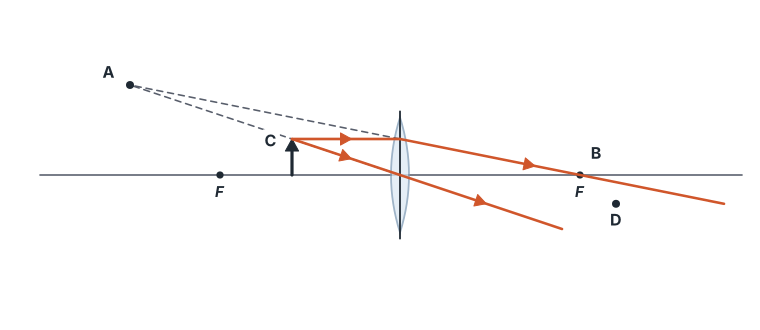
Supplement. The diagram shows a ray diagram for an object closer to a converging lens than its principal focus. Which letter marks the tip of the image?
Circle one answer.
- A
- B
- D
- No image
Nudge (only if you are stuck): After the lens these rays never cross. Which lines show where the light only seems to come from?
7. determine / describe / state
Supplement. A converging lens has a focal length of 5.0 cm. An object 1.0 cm tall stands on the principal axis 3.0 cm from the lens. On paper, draw a full-size ray diagram. Determine (a) the distance of the image from the lens and (b) the height of the image. (c) Describe the image and state which side of the lens it is on.
(a) Distance of the image from the lens: ______________ unit ________
(b) Height of the image: ______________ unit ________
(c) Describe the image and state its side
Nudge (only if you are stuck): If the two rays never cross after the lens, where can the image be? Leave room on that side of your paper.
8. identify
Supplement. A pupil has two magnifying glasses: lens P has a focal length of 4.0 cm, and lens Q has a focal length of 8.0 cm. She wants the tallest upright image of an ant. Which row gives it?
| Row | Lens | Distance of the ant from the lens |
|---|---|---|
| A | P | 1.0 cm |
| B | Q | 3.5 cm |
| C | P | 3.5 cm |
| D | P | 5.0 cm |
Circle one answer.
- A
- B
- C
- D
Nudge (only if you are stuck): For each row, compare the distance of the ant with that lens’s focal length.
9. describe / explain / state
Supplement. A pupil holds a magnifying glass of focal length 8 cm above a page of a recipe book, with her eye close to the glass, and slowly lifts the glass. (a) Describe the image when the glass is 5 cm above the paper. (b) With the glass 12 cm above the paper, the letters look blurred. Explain why. (c) She keeps the glass 12 cm above the paper and moves her head back until her eye is about 50 cm above the glass. The letters look sharp again. Describe how they look now, and state whether this image is real or virtual.
(a) The image at 5 cm
(b) Why the letters blur at 12 cm
(c) The letters with her eye far back
Nudge (only if you are stuck): Compare 5 cm and 12 cm with the focal length. For (c), think about where the rays are when they reach her eye.
10. identify
Supplement. Match each statement about sight to the right answer.
Write the number of the matching option.
- Near objects
- A diverging lens
- A converging lens
- Distant objects
- A short-sighted person sees these blurred: ______
- A short-sighted eye is corrected with: ______
- A long-sighted person sees these blurred: ______
- A long-sighted eye is corrected with: ______
Nudge (only if you are stuck): Which can an eye bring together too soon: rays from far away, or rays from close by?
11. identify
Supplement. Ravi is short-sighted. An optician holds two lenses in turn in front of his eye while he looks at a chart across the room. Through lens J the chart becomes sharp. Through lens K it becomes even more blurred than without a lens. Which statement explains what lens K does?
Circle one answer.
- K is converging, so the rays meet even further in front of the retina.
- K is converging, so the letters look bigger and run into each other.
- K is diverging, so the rays meet still further in front of the retina.
- K is converging, so the rays meet later, further behind the retina.
Nudge (only if you are stuck): Where do the rays from the chart meet in Ravi’s eye without a lens? Which way must that point move to reach the retina?
12. identify
Supplement. An optician’s poster has four small eye diagrams, described in the table. In each, rays from one object enter an eye, in some diagrams through a lens first. Which diagram shows a short-sighted eye with its sight corrected?
| Diagram | The rays come from | Lens in front of the eye | Where the rays meet |
|---|---|---|---|
| A | a phone held close | none | on the retina |
| B | a distant hill | converging | on the retina |
| C | a distant hill | none | in front of the retina |
| D | a distant hill | diverging | on the retina |
Circle one answer.
- A
- B
- C
- D
Nudge (only if you are stuck): Which objects does a short-sighted eye see blurred? Without help, where do the rays from them meet?
13. identify
Supplement. Leila can read the departures board on the far side of the station easily, but the small print on the ticket in her hand looks blurred. Which row is correct for Leila’s eye and her glasses?
| Row | Rays from the ticket would meet | Lens in her glasses | What the lens does to the rays first |
|---|---|---|---|
| A | in front of the retina | diverging | spreads them out a little |
| B | behind the retina | converging | brings them together a little |
| C | behind the retina | diverging | spreads them out a little |
| D | in front of the retina | converging | brings them together a little |
Circle one answer.
- A
- B
- C
- D
Nudge (only if you are stuck): Which does Leila see blurred: near things or distant things? Which sight problem is that?
14. describe / explain / determine
A jeweller looks at a diamond through a loupe: a small converging lens of focal length 2.5 cm, held close to the eye. (a) The jeweller moves the loupe until the diamond is 4.0 cm from it. Describe the image the loupe now forms. Explain why a card could show this image, while no card could show the image the jeweller saw with the diamond closer than 2.5 cm. (b) Supplement. The diamond is put 2.0 cm from the loupe. On paper, draw a ray diagram twice full size (1 cm on the paper for 0.5 cm). Determine how far from the loupe the image is, in real centimetres. (c) Supplement. A short-sighted customer takes off her glasses and holds a ring close to her eye to read the tiny letters engraved inside it. Explain why she sees the letters clearly without her glasses, and why her diverging glasses would make them harder to see.
(b) Supplement: Distance of the image from the loupe (real cm): ______________ unit ________
(a) The image at 4.0 cm and the card, and (c) Supplement: the customer without her glasses
Nudge (only if you are stuck): A loupe is a magnifying glass. For (b), on paper twice full size, is each length longer or shorter than the real one? For (c), which things does a short-sighted person see clearly?