Pupil sheet · Lenses and images
Lenses and real images — questions
Name ______________________ Date ____________
Try every question before you use a nudge. Write in full sentences where you are asked to explain.
1. identify
The diagram shows a parallel beam of light passing through a converging lens. Match each numbered part of the diagram to what it is.
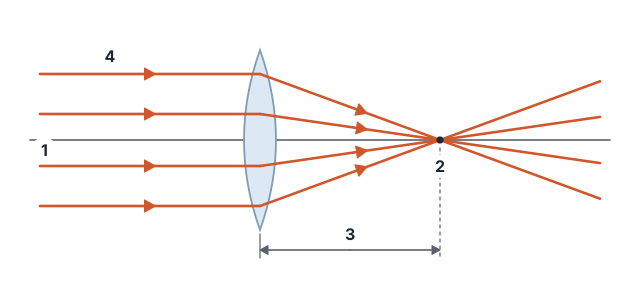
Write the number of the matching option.
- A ray parallel to the principal axis
- The focal length
- The principal axis
- The principal focus
- Part 1: ______
- Part 2: ______
- Part 3: ______
- Part 4: ______
Nudge (only if you are stuck): One is a line, one is a point, one is a distance and one is a ray.
2. describe
Light from a lamp far away reaches a thin diverging lens as a parallel beam. Which statement describes the rays after the lens?
Circle one answer.
- The rays spread apart; traced back, they seem to start at one point on the lamp’s side.
- The rays stay parallel to each other, but the lens squeezes them into a narrower beam.
- The rays stay parallel to each other, because a thin lens hardly bends any of them.
- The rays meet at one point beyond the lens, then spread apart again after that point.
Nudge (only if you are stuck): A diverging lens is thinner in the middle than at its edges. Is that the shape that brings rays together, or the other one?
3. calculate
A pupil stands at one end of a school corridor 25 m long, facing a lamp lit on the far wall. She points a metre rule at the lamp, with its 100 cm end nearer the lamp, and holds a converging lens at the 62.0 cm mark. She slides a white card along the rule on her side of the lens until a sharp image of the lamp appears on it at the 49.5 cm mark. Calculate the focal length of the lens. Give your answer to 3 significant figures.
Focal length: ______________ unit ________
Nudge (only if you are stuck): Compare 25 m with the distances on the rule. How do the rays from a lamp that far away arrive at the lens?
4. identify
In a ray diagram for a converging lens, three rays from the tip of the object are easy to draw. Match each ray, as it reaches the lens, to what it does after the lens.
Write the number of the matching option.
- Is refracted parallel to the principal axis
- Is refracted through the principal focus on the far side
- Goes straight on
- A ray parallel to the principal axis: ______
- A ray through the centre of the lens: ______
- A ray through the principal focus on the near side: ______
Nudge (only if you are stuck): Where on a thin lens are the two faces parallel to each other?
5. identify
A lens throws a picture of a candle flame onto a wall. The real flame is 3 cm tall and points up. On the wall the flame is 1 cm tall and points down. Identify the word that fills each gap. The image on the wall is ____ (1), because it is upside down, and ____ (2), because it is shorter than the flame. A sheet of paper held there would show it, so the image is ____ (3). If the lens and the wall were moved until the flame on the wall was 6 cm tall, that image would be ____ (4).
Gap 1
Gap 2
Gap 3
Gap 4
Nudge (only if you are stuck): Use the three pairs of words for describing an image: its size, which way up it is, and real or virtual.
6. identify / explain
The diagram shows three rays, A, B and C, drawn from the tip of an object through a converging lens. One of them is drawn wrongly. Identify that ray, and explain why it is wrong.
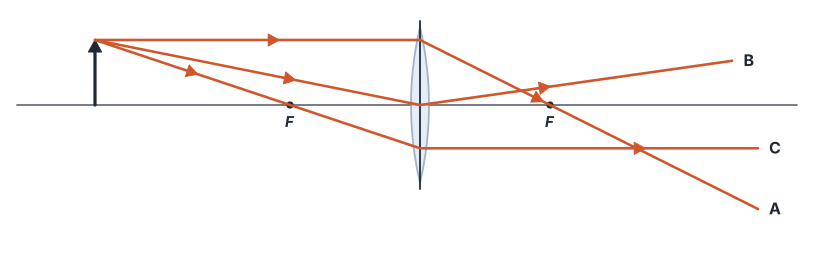
Circle one answer.
- A
- B
- C
Why that ray is wrong
Nudge (only if you are stuck): Check each ray against the three rules: parallel → through F, centre → straight on, through F → parallel.
7. identify
A converging lens has a focal length of 15 cm. An object is placed first 40 cm from the lens, then 22 cm from it. Which row describes the two images correctly?
| Row | Object 40 cm from the lens | Object 22 cm from the lens |
|---|---|---|
| A | real, inverted, enlarged | real, inverted, diminished |
| B | virtual, upright, diminished | real, inverted, enlarged |
| C | real, inverted, diminished | real, inverted, enlarged |
| D | real, inverted, diminished | virtual, upright, enlarged |
Circle one answer.
- A
- B
- C
- D
Nudge (only if you are stuck): Which two distances, measured from the lens, decide what the image of a converging lens is like?
8. determine
A converging lens has a focal length of 3.0 cm. An object 3.0 cm tall stands on the principal axis 7.5 cm from the lens. On paper, draw a full-size ray diagram with two rays from the tip of the object. Determine (a) the distance of the image from the lens and (b) the height of the image.
(a) Distance of the image from the lens: ______________ unit ________
(b) Height of the image: ______________ unit ________
Nudge (only if you are stuck): Which two rays from the tip of the object are the quickest to draw?
9. determine
A converging lens has a focal length of 6.0 cm. An object 2.0 cm tall stands on the principal axis 8.0 cm from the lens. On paper, draw a ray diagram to scale, with 1 cm on your paper for 2 cm. Determine (a) the distance of the image from the lens and (b) the height of the image, both in real centimetres.
(a) Distance of the image from the lens (real cm): ______________ unit ________
(b) Height of the image (real cm): ______________ unit ________
Nudge (only if you are stuck): With 1 cm for 2 cm, is each length on your paper longer or shorter than the real one?
10. state / determine / explain
A pupil draws a ray diagram for an object 4.0 cm tall standing on the principal axis of a converging lens. From the tip of the object she draws ray 1, parallel to the principal axis, and ray 3, through the principal focus on the near side. Ray 3 reaches the lens 1.0 cm below the principal axis. (a) State the direction of ray 3 after the lens. (b) Determine the height of the image. (c) State whether the image is upright or inverted, and explain how the diagram shows it.
(b) Height of the image: ______________ unit ________
(a) The direction of ray 3 after the lens, and (c) upright or inverted, and how the diagram shows it
Nudge (only if you are stuck): Which rule does ray 3 follow at the lens? Then ask: which point of the image do all the rays from the tip of the object reach?
11. describe
A pupil wants to find the focal length of a converging lens on an optical bench, and then check it with an image the same size as the object. Put her steps in order.
Write the number of each step in order.
- Slide the screen along the bench until the arrow’s image is sharp.
- Focus the image of a distant flagpole on the screen.
- Measure the distance from the centre of the lens to the screen.
- Check the image: as tall as the arrow, and as far from the lens as the arrow.
- Put the lamp’s arrow at twice that distance from the lens.
- Step 1: ______
- Step 2: ______
- Step 3: ______
- Step 4: ______
- Step 5: ______
Nudge (only if you are stuck): Which step needs a number that an earlier step gives?
12. determine / calculate
In an experiment with a converging lens, a pupil finds that the image on the screen is the same size as the object when the object is 36 cm from the lens. (a) Determine how far the screen is from the lens. (b) Calculate the focal length of the lens.
(a) Distance from the lens to the screen: ______________ unit ________
(b) Focal length: ______________ unit ________
Nudge (only if you are stuck): Where must the object be for a same-size image?
13. identify / calculate
A pupil measures the focal length of one converging lens five times. Each time she focuses a distant chimney on a card and measures from the centre of the lens to the card. Her results are 16.6 cm, 16.9 cm, 13.8 cm, 16.7 cm and 17.0 cm. (a) Identify the anomalous result. (b) Calculate the focal length she should record. Give your answer to 3 significant figures.
(a) The anomalous result: ______________ unit ________
(b) The focal length to record: ______________ unit ________
Nudge (only if you are stuck): Which result does not fit the pattern of the others? What would it do to a mean?
14. explain / describe / state
A phone camera has a converging lens of focal length 4.0 mm in front of its sensor. (a) A friend stands 3 m away. Explain why the image of the friend is formed very close to 4.0 mm behind the lens. (b) Describe the image on the sensor. (c) To take a sharp photo of a flower only 10 cm away, the lens moves a little. State whether it moves towards or away from the sensor, and explain why.
(a) Why about 4.0 mm
(b) The image
(c) Towards or away from the sensor
Nudge (only if you are stuck): Compare 3 m with the focal length. And remember what your results showed for nearer objects.