Pupil sheet · Energy, work and power
Work and power — questions
Name ______________________ Date ____________
Try every question before you use a nudge. Write in full sentences where you are asked to explain.
1. calculate
A child pulls a sledge (a small sled) 3.0 m across the snow with a steady horizontal force of 40 N. Calculate the work done by the child.
Work done: ______________ unit ________
Nudge (only if you are stuck): Work done = force × distance moved in the direction of the force.
2. identify
A gardener uses a wheelbarrow full of soil. In which of these does a force do work on the wheelbarrow?
Circle one answer.
- She pushes it 15 m along a level garden path
- She pushes hard, but its wheel is stuck in the mud
- She holds its handles up while she stands still
- It rests on the grass, which pushes up on it
Nudge (only if you are stuck): For each one, ask: does the wheelbarrow move in the direction of the force?
3. calculate
A worker pushes a trolley up a straight ramp with a steady force of 120 N along the ramp, as in the diagram. Calculate the work done by the worker in pushing the trolley from the bottom to the top of the ramp.
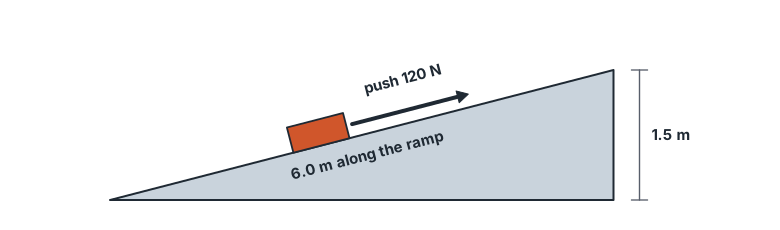
Work done: ______________ unit ________
Nudge (only if you are stuck): Which distance is in the direction of the push: along the ramp or straight up?
4. calculate / explain
A battery does 450 J of electrical work on a small electric motor. The motor winds up a string and lifts a 15 N weight steadily. (a) Calculate the greatest height through which the motor could lift the weight with this energy. (b) Explain why the motor in fact lifts the weight less high than this.
(a) Greatest height: ______________ unit ________
(b) Why the weight is lifted less high
Nudge (only if you are stuck): For (a), electrical work done is equal to the energy transferred, and at most all of it could go to the weight. For (b), what do you notice about a motor that has been running for a while?
5. calculate
A cyclist and her bicycle have 1800 J in their kinetic store. She brakes with a steady braking force of 240 N until she stops. Calculate the distance she travels while braking.
Braking distance: ______________ unit ________
Nudge (only if you are stuck): How much work must the braking force do to stop her? Then rearrange W = F d.
6. calculate
An electric motor does 6000 J of work in 25 s. Calculate its power.
Power: ______________ unit ________
Nudge (only if you are stuck): Power = work done ÷ time.
7. identify
Two electric hoists on a building site each raise the same pallet of tiles through the same height. Hoist B has three times the power of hoist A. Which statement is correct?
Circle one answer.
- Both do the same work, and hoist B takes a third of the time
- Hoist B does three times the work, and takes the same time
- Hoist B does three times the work, in a third of the time
- Both do the same work, and hoist B takes three times as long
Nudge (only if you are stuck): The work depends on the force and the distance. Power is how fast the work is done.
8. calculate
A hairdryer has a power of 1.5 kW. It is used for 4.0 minutes. Calculate the energy it transfers.
Energy transferred: ______________ unit ________
Nudge (only if you are stuck): Which units must the power and the time be in before you use P = ΔE / t?
9. calculate
A motor raises a small bridge over a canal so that a boat can pass. It does 36 kJ of work on the bridge at a power of 1200 W. Calculate the time it takes.
Time: ______________ unit ________
Nudge (only if you are stuck): Check the units of the work and the power first. Then rearrange P = W / t.
10. calculate
A 0.50 kg ball is rolling at 4.0 m/s. Calculate its kinetic energy.
Kinetic energy: ______________ unit ________
Nudge (only if you are stuck): Ek = ½ m v². Square the speed first.
11. calculate
A 2.0 kg bag of shopping is lifted from the floor onto a table 1.5 m higher. Calculate the change in its gravitational potential energy. The gravitational field strength g is 9.8 N/kg.
Change in gravitational potential energy: ______________ unit ________
Nudge (only if you are stuck): ΔEp = m g Δh.
12. calculate
A ball is dropped from rest from a height of 5.0 m. Air resistance is small enough to ignore. Calculate its speed just before it hits the ground.
Speed: ______________ unit ________
Nudge (only if you are stuck): Where does the lost gravitational potential energy go? Do you need the mass?
13. deduce
Car P has twice the mass of car Q, but car Q is moving at twice the speed of car P. Which statement about their kinetic energies is correct?
Circle one answer.
- The two cars have the same kinetic energy
- Car Q has four times the kinetic energy of car P
- Car Q has twice the kinetic energy of car P
- Car P has twice the kinetic energy of car Q
Nudge (only if you are stuck): Write Ek = ½ m v² for each car, with m for car Q’s mass and v for car P’s speed.
14. calculate
A skier starts from rest and skis down a slope, dropping 100 m in height. At the bottom she is moving at 20 m/s and has 12 000 J in her kinetic store. (a) Calculate her mass. (b) Calculate the gravitational potential energy she loses. (c) Calculate the energy transferred to the internal store of the snow, her skis and the air on the way down.
(a) Mass of the skier: ______________ unit ________
(b) Gravitational potential energy lost: ______________ unit ________
(c) Energy to the internal store: ______________ unit ________
Nudge (only if you are stuck): For (a), rearrange Ek = ½ m v². For (c), energy is conserved.
15. calculate / explain
A lift (elevator) in a building raises its car and passengers, of total weight 8000 N, through 15 m in 12 s. (a) Calculate the work done by the lift motor on the car. (b) Calculate the power of the motor in doing this work. (c) A newer motor of power 15 kW raises the same car through the same 15 m. Calculate the time it takes. (d) Explain why the newer motor does not transfer more energy to the car’s gravitational potential store.
(a) Work done: ______________ unit ________
(b) Power of the first motor: ______________ unit ________
(c) Time for the newer motor: ______________ unit ________
(d) Why the newer motor does not transfer more energy
Nudge (only if you are stuck): For (a), what upward force must the motor give to raise the car steadily? For (c), check the unit of the power first. For (d), what does the work done depend on?
16. calculate
A 50 kg diver steps off a platform 10 m above the water. Air resistance is small enough to ignore. (a) Calculate the gravitational potential energy she loses as she falls to the water. (b) Calculate her speed as she reaches the water.
(a) Gravitational potential energy lost: ______________ unit ________
(b) Speed at the water: ______________ unit ________
Nudge (only if you are stuck): For (b), where does the energy she loses go, and which equation links it to her speed?