Pupil sheet · Energy, work and power
Energy stores and transfers — questions
Name ______________________ Date ____________
Try every question before you use a nudge. Write in full sentences where you are asked to explain.
1. identify
A pupil rubs a plastic ruler with a dry cloth. A minute later the ruler is no warmer than the room, but it still pulls small bits of paper up towards it. In which store does the ruler have the energy that lets it pull the paper?
Circle one answer.
- Electrostatic
- Chemical
- Nuclear
- Kinetic
Nudge (only if you are stuck): Rule stores out one by one: is the ruler moving, stretched, warmer than the room, or burning? What did rubbing change on its surface?
2. identify
Match each object to the energy store that it shows most clearly.
Write the number of the matching option.
- Gravitational potential
- Elastic (strain)
- Chemical
- Electrostatic
- Kinetic
- Nuclear
- Internal (thermal)
- A candle that has not been lit yet: ______
- A bicycle rolling along a flat road: ______
- A hot clothes iron: ______
- A flowerpot on a high window ledge: ______
- Clothes that cling together after a tumble dryer has charged them: ______
- A stretched bungee cord: ______
- Radioactive americium in a smoke alarm: ______
Nudge (only if you are stuck): For each one, ask what it could do later: move something, fall, burn, spring back, warm something, attract or repel, or release energy from its nuclei.
3. state / explain
A skateboarder stands still at the top of one side of a U-shaped ramp. She rolls down to the bottom and up the other side without pushing. (a) State the store that empties as she rolls down. (b) State the store that empties and the store that fills as she rolls up the other side. (c) Her friend says: “At the end, the wheels are warm, so they have heat stored in them.” Explain what is wrong with this.
(a) The store that empties rolling down
(b) Rolling up the other side
(c) What is wrong
Nudge (only if you are stuck): In (a) and (b), is she getting lower or higher, faster or slower? For (c), look again at the list of seven stores.
4. identify
For each event, choose how the energy is mainly transferred.
Write the number of the matching option.
- Heating
- Sound waves
- Electromagnetic waves
- A force doing work (mechanical work done)
- An electric current (electrical work done)
- A crane lifting a load: ______
- The current in the wires of a toaster: ______
- A hot radiator warming the air in a room: ______
- Light from a lighthouse reaching a ship at sea: ______
- The sound of a drum reaching you across a field: ______
Nudge (only if you are stuck): Is something pushed or pulled through a distance, is there a current, is a hotter thing warming a cooler one, or do waves carry the energy?
5. identify
A battery-powered torch is switched on. Which row describes the energy transfers correctly?
| Row | Store the energy starts in | How energy reaches the lamp | How energy leaves the lamp |
|---|---|---|---|
| A | electrical store of the battery | by electrical work (a current) | by light and by heating |
| B | chemical store of the battery | by heating | by light and by heating |
| C | chemical store of the battery | by electrical work (a current) | by light and by heating |
| D | chemical store of the battery | by electrical work (a current) | by light only |
Circle one answer.
- A
- B
- C
- D
Nudge (only if you are stuck): Take one column at a time, and check each entry against the reading’s list of stores and of the ways energy is transferred.
6. state / describe
A carpenter uses an electric drill, plugged into the mains, to make a hole in a piece of wood. The drill buzzes, and the metal drill bit (the part that cuts the hole) gets hot. (a) State how energy is transferred from the mains to the drill. (b) Describe how energy is transferred to the internal store of the bit and the wood. (c) State how the hot bit transfers energy to the air around it. (d) State how energy reaches the carpenter’s ears.
(a) From the mains to the drill
(b) To the internal store of the bit and the wood
(c) From the hot bit to the air
(d) To the carpenter’s ears
Nudge (only if you are stuck): For (b), what acts between the turning bit and the wood, and does it move through a distance? For (c) and (d), go through the ways energy can be transferred.
7. calculate
The flow diagram shows the energy transferred by a lamp in one second. Use the principle of the conservation of energy to calculate the energy that heats the lamp and the air each second.
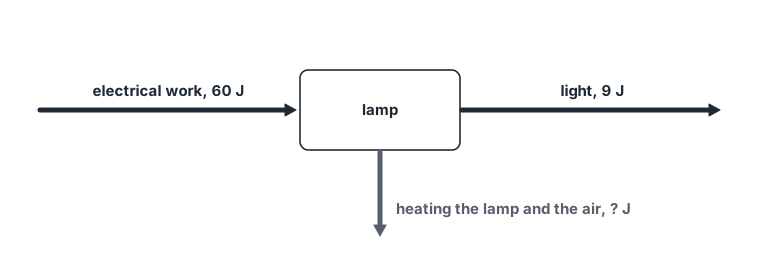
Energy heating the lamp and the air: ______________ unit ________
Nudge (only if you are stuck): Energy out must equal energy in.
8. identify
A child on a swing is pushed once and then left to swing. Each swing is a little lower than the one before. Which statement explains this correctly?
Circle one answer.
- Air resistance and friction use up the force that the push gave to the swing
- Air resistance and friction transfer energy to the internal store of the surroundings
- Air resistance and friction destroy a little of the energy at every single swing
- Air resistance and friction keep some of the energy as heat stored in the air
Nudge (only if you are stuck): Check each statement against the principle of the conservation of energy and against the list of seven stores.
9. describe / explain / state
A child slides down a playground slide and then along the flat sandy ground at the bottom until she stops. (a) Describe the energy changes from the top of the slide until she stops. (b) At the top of the slide she has 900 J in her gravitational potential store. Her friend says: “At the bottom of the slide she has 1100 J in her kinetic store.” Explain why this must be incorrect. (c) State the condition under which she could have 900 J in her kinetic store at the bottom of the slide.
(a) The energy changes
(b) Why 1100 J is incorrect
(c) The condition for 900 J
Nudge (only if you are stuck): For (a), which store fills as she speeds up, and what does the sand do to her? For (b) and (c), can energy be created, and where else can some of it go on the way down?
10. identify
The four Sankey diagrams are each for an electric motor supplied with 100 J, and they are drawn to the same scale. Which diagram could be correct for a motor that wastes less than half of the energy supplied to it?
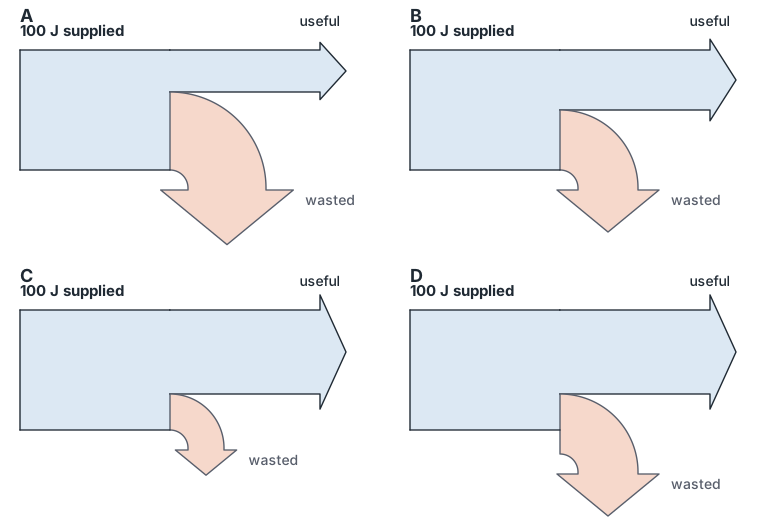
Circle one answer.
- A
- B
- C
- D
Nudge (only if you are stuck): In each diagram, compare the two arrows coming out with the arrow going in. Then compare the two arrows coming out with each other.
11. calculate
Each second, a car engine is supplied with 100 J from the chemical store of its fuel. 25 J goes to the kinetic store of the car, 5 J leaves as sound, and the rest heats the engine and the air. (a) Calculate the energy that heats the engine and the air each second. (b) In a Sankey diagram drawn to scale, the 100 J arrow is 50 mm wide. Calculate the width of the arrow for the energy that heats the engine and the air.
(a) Energy heating the engine and the air: ______________ unit ________
(b) Width of that arrow: ______________ unit ________
Nudge (only if you are stuck): For (b), each millimetre of width stands for the same amount of energy.
12. state / describe / explain
A pole vaulter sprints along the track, plants her long pole, bends it and is lifted over a high bar, then falls onto a thick soft mat. (a) State the store that fills as she speeds up along the track. (b) State the store in which the bent pole has energy. (c) Describe how the bent pole transfers energy to her as it straightens. (d) She stops on the mat. Explain, using the principle of the conservation of energy, where her energy has gone.
(a) The store that fills
(b) The bent pole
(c) How the pole transfers energy
(d) Where the energy goes
Nudge (only if you are stuck): Follow the energy from stage to stage: running, bending the pole, rising over the bar, landing.
13. calculate
The flow diagram shows the energy transfers when a kettle boils water using electricity from a fuel-burning power station, for every 100 J in the fuel’s chemical store. (a) Calculate the energy that leaves the power station by electrical work in the cables. (b) Supplement. Calculate the energy that reaches the internal store of the water. (c) Supplement. Calculate the total energy wasted, and check that the useful and wasted energy add up to 100 J.
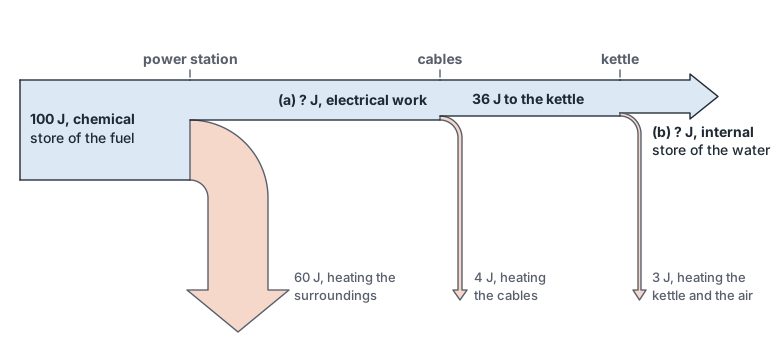
(a) Energy in the cables: ______________ unit ________
(b) Supplement: Energy reaching the water: ______________ unit ________
(c) Supplement: Total energy wasted: ______________ unit ________
Nudge (only if you are stuck): At each split, the energy out equals the energy in. Work along the diagram from left to right.