Pupil sheet · Energy resources
Choosing energy resources — questions
Name ______________________ Date ____________
Try every question before you use a nudge. Write in full sentences where you are asked to explain.
1. identify
Match each energy resource to whether it is renewable or non-renewable.
Write the number of the matching option.
- Non-renewable
- Renewable
- Coal: ______
- Natural gas: ______
- Uranium (a nuclear fuel): ______
- Wind: ______
- Wood pellets (a biofuel): ______
- The tides: ______
- Sunlight: ______
- Water behind a hydroelectric dam: ______
- Geothermal energy: ______
Nudge (only if you are stuck): A renewable resource is replaced by nature as fast as we use it, or is not used up at all.
2. identify
Each fact below answers one of the five questions to ask about an energy resource. Match each fact to the question it answers.
Write the number of the matching option.
- Environmental impact
- Renewability
- Availability
- Reliability
- Scale
- A country with no coastline cannot build wave machines or a tidal barrage.: ______
- A small hydroelectric scheme stops generating when its stream dries up in a long drought.: ______
- One large wind turbine gives at most about 3 MW, but a big city can need 2000 MW.: ______
- Wind turbines can kill birds that fly into their blades.: ______
- Once coal is burnt it is gone, but new willow trees can be grown for wood pellets.: ______
Nudge (only if you are stuck): Ask of each fact: is it about running out, being found in that place, being there whenever it is needed, size, or harm to the surroundings?
3. explain
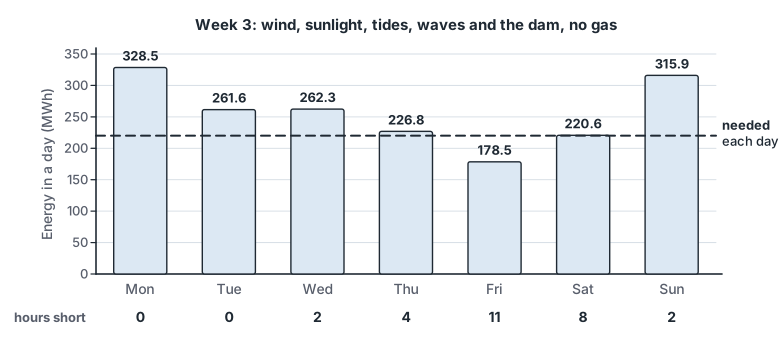
The bar chart shows the energy that the wind farm, solar cells, tidal barrage, wave machines and dam could supply on each day of week 3 in the model town, with the gas-fired power station off. The town needs 220 MWh every day. Over the week these resources could supply 1794 MWh, more than the 1540 MWh needed, yet the town was short of power for 27 hours. Which statement explains this best?
Circle one answer.
- The turbines and cells destroyed some of the energy
- The town needed more energy in week 3 than in week 1
- Every day, the energy supplied was less than 220 MWh
- On calm evenings, the power was less than the demand
Nudge (only if you are stuck): Look at Wednesday and Thursday on the chart: compare each day’s total with the hours short.
4. identify
Which of these statements about energy resources are correct? Select all that apply.
Tick every correct statement.
- Renewable resources produce no pollution and do no harm.
- A hydroelectric dam floods a valley and destroys habitats.
- Wind turbines give a steady power, whatever the weather.
- Biofuels are renewable, but burning them releases carbon dioxide.
- A renewable resource can still harm the environment.
- Biofuels are zero-emission, because they are renewable.
Nudge (only if you are stuck): Renewable tells you whether a resource runs out. Does it tell you anything about its environmental impact?
5. describe / explain
In the model town, the dam’s turbines give at most 6 MW and its reservoir holds at most 150 MWh of energy; the river refills it slowly, at 0.5 MW. The town’s demand peaks at 14 MW, and it needs 1540 MWh in a week. (a) Describe one advantage of the dam over the wind farm, in terms of reliability. (b) Explain why the dam alone cannot supply the town. (c) Describe one disadvantage of a dam, in terms of environmental impact.
(a) Advantage: reliability
(b) Why the dam alone cannot supply the town
(c) Disadvantage: environmental impact
Nudge (only if you are stuck): For (a), can the dam choose when to generate? For (b), look at both of the dam’s limits: how fast it can give energy, and how much it holds. For (c), what happens to the valley behind a dam?
6. explain / suggest / describe
In week 3 the model town ran without gas and was short of power for 27 hours. In week 4 the gas-fired power station was kept as a backup: no hours were short, and it burnt 221 MWh of gas, releasing 44 t of carbon dioxide, compared with 3850 MWh and 770 t in week 1 with gas alone. (a) Explain why the town still needs a backup. (b) Suggest why a nuclear power station would not be a good backup for this town, whose demand peaks at 14 MW. (c) The model town is built on cold, ordinary rock. Suggest why a geothermal power station is not possible here. (d) Describe one advantage and one disadvantage of keeping the gas-fired power station as the backup.
(a) Why a backup
(b) Not nuclear
(c) Not geothermal
(d) Keeping the gas-fired power station
Nudge (only if you are stuck): What were the renewables doing in the short hours? For (b) and (c), think about the size of each kind of power station and what it needs. For (d), what can gas do at any hour, and what happens when it burns?
7. identify
A farm burns biogas in an engine that turns a generator. For every 200 J of energy from the burning biogas, the generator gives 60 J of electrical energy. What happens to the other 140 J?
Circle one answer.
- It heats the engine, the generator and the air
- It is destroyed inside the engine as it runs
- It goes back into the biogas’s chemical store
- It is stored in the generator for use later
Nudge (only if you are stuck): Energy is conserved. Touch an engine that has been running for an hour: what has happened to it?
8. identify
Which of these statements about efficiency are correct? Select all that apply.
Tick every correct statement.
- Whether an output is useful depends on what the device is for.
- Efficiency compares the useful energy output with the total input.
- An efficient device destroys less energy than an inefficient one.
- A device with a high efficiency wastes more of its energy.
- In most devices, the wasted energy ends up heating the surroundings.
- No device can be more than 100 % efficient.
Nudge (only if you are stuck): Remember that energy is never created or destroyed. Which part of the output does efficiency count?
9. state / explain
The model town’s gas-fired power station turns 40 % of the energy from its gas into electrical energy. A newer gas-fired power station turns about 55 % into electrical energy. (a) State which power station is more efficient. (b) Explain why the newer power station burns less gas to give the town the same electrical energy. (c) Explain why no power station can turn all the energy from its fuel into electrical energy.
(a) More efficient
(b) Why less gas
(c) Why never all of it
Nudge (only if you are stuck): Efficiency is the share of the energy put in that comes out as useful energy. For (c), what always warms up when a power station runs?
10. calculate
A camping stove burns gas that releases 2000 kJ of energy. The water in the pan on it gains 700 kJ. Calculate the efficiency of the stove.
Efficiency: ______________ unit ________
Nudge (only if you are stuck): Which number is the useful output, and which is the total input?
11. calculate
The motor of a food mixer takes in 500 W of electrical power and gives a useful power output of 320 W to the blades. Calculate its efficiency.
Efficiency: ______________ unit ________
Nudge (only if you are stuck): Use the power form of the efficiency equation. Which power is the useful output?
12. calculate
In a hydroelectric power station, the water flowing down to the turbines loses 400 kJ from its gravitational potential store every second. The power station is 90 % efficient. Calculate the useful electrical energy output every second.
Useful electrical energy output each second: ______________ unit ________
Nudge (only if you are stuck): Start from efficiency = useful output ÷ total input, and rearrange it for the useful output. Should the answer be bigger or smaller than 400 kJ?
13. calculate
A solar-cell panel on a school roof is 20 % efficient. At noon it gives an electrical power output of 300 W. Calculate the power of the light falling on it.
Power of the light falling on the panel: ______________ unit ________
Nudge (only if you are stuck): Here 300 W is the useful power output. Rearrange the efficiency equation for the total power input. Should the answer be bigger or smaller than 300 W?
14. calculate
The table shows what happens to every 1000 kJ of energy in the wood pellets burnt in a biofuel power station. (a) Calculate the energy wasted in the boiler. (b) Calculate the total energy wasted in the whole power station. (c) Calculate the efficiency of the whole power station.
| Stage | Energy in | Energy passed on usefully |
|---|---|---|
| Boiler | 1000 kJ, from the burning pellets | 880 kJ, to the steam |
| Turbine | 880 kJ, from the steam | 400 kJ, to the generator’s shaft |
| Generator | 400 kJ, from the shaft | 380 kJ of electrical energy, to the cables |
(a) Energy wasted in the boiler: ______________ unit ________
(b) Total energy wasted: ______________ unit ________
(c) Efficiency of the whole power station: ______________ unit ________
Nudge (only if you are stuck): Energy is conserved at every stage: what goes in comes out, usefully or wasted. For (c), which numbers are the useful output and the total input of the whole station?
15. suggest / describe / explain
An island community generates all its electricity with a diesel generator, and the diesel arrives by ship. The island has a narrow bay with a large tidal range, and strong but changeable winds. (a) Suggest one advantage of a tidal barrage across the bay over wind turbines, in terms of reliability. (b) Describe one disadvantage of the tidal barrage, in terms of environmental impact. (c) The islanders plan to run the generator on biofuel made from used cooking oil. Explain why this fuel is renewable but not free of carbon dioxide emissions. (d) Explain why the island should keep a generator even after it has built the barrage and the wind turbines.
(a) Tidal barrage or wind: reliability
(b) Environmental impact of the barrage
(c) Biofuel from cooking oil
(d) Why keep a generator
Nudge (only if you are stuck): For (a), can you know in advance when each will give power? For (b), what lives in and around a bay? For (c), what is the oil made from, and what happens when it burns? For (d), think about the hours when neither gives power.
16. calculate / explain
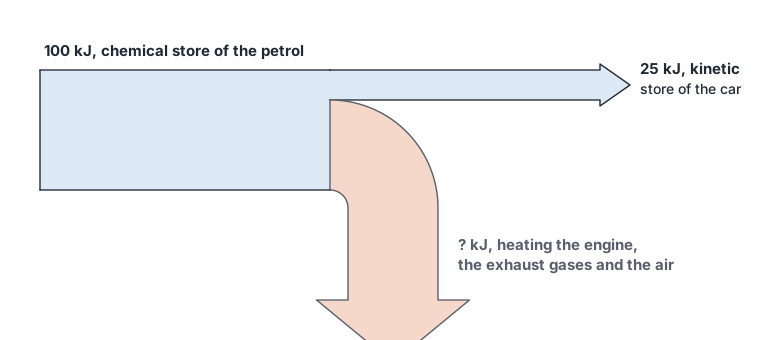
The Sankey diagram shows what happens to every 100 kJ of energy from the petrol in a car engine. (a) Calculate the energy wasted, heating the engine, the exhaust gases and the air. (b) Supplement. Calculate the efficiency of the engine. (c) Explain why the engine can never be 100 % efficient.
(a) Energy wasted: ______________ unit ________
(b) Supplement: Efficiency: ______________ unit ________
(c) Why never 100 %
Nudge (only if you are stuck): Energy out equals energy in. Which arrow is the useful one? For (c), what warms up when an engine runs?