Pupil sheet · Energy resources
Where electricity comes from — questions
Name ______________________ Date ____________
Try every question before you use a nudge. Write in full sentences where you are asked to explain.
1. identify / describe
The diagram shows the main parts of a gas-fired power station, labelled A to D. Match each part to what it does.
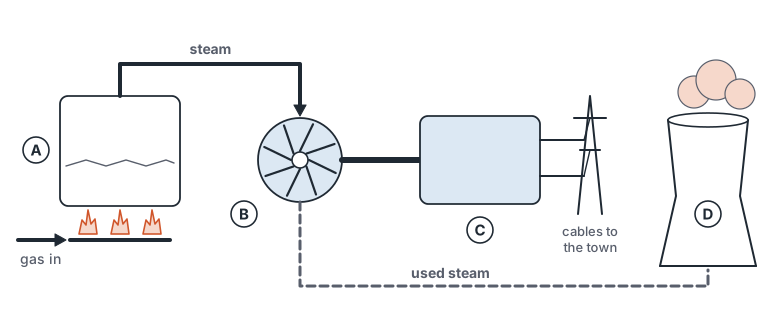
Write the number of the matching option.
- Is pushed round by the steam, so that its shaft spins
- Cools the used steam, carrying wasted energy into the air
- Stores the electricity until the town switches it on
- Is turned by the shaft and generates the electric current
- Heats water until it boils into high-pressure steam
- Part A: ______
- Part B: ______
- Part C: ______
- Part D: ______
Nudge (only if you are stuck): Follow the energy from the gas flames: what is heated first, what is pushed round, and what makes the current?
2. identify
A tidal barrage is a low dam across an estuary. Which row shows the parts that a tidal barrage uses to generate electricity?
| Row | Boiler | Turbine | Generator |
|---|---|---|---|
| A | used | used | used |
| B | not used | used | used |
| C | not used | not used | used |
| D | used | used | not used |
Circle one answer.
- A
- B
- C
- D
Nudge (only if you are stuck): Follow the energy of the water held behind the barrage until it becomes a current. Which parts does it pass through?
3. identify / describe
Match each energy resource to the way it is used to generate electricity.
Write the number of the matching option.
- Its atoms’ nuclei release energy that boils water into steam
- Moving air pushes the blades of a turbine round
- Light makes a current directly, with no turbine at all
- Water pumped down to them comes back up as steam
- Moving water pushes a turbine round; no steam is needed
- Burnt in a boiler to boil water into steam for a turbine
- Coal: ______
- Wood pellets (a biofuel): ______
- Uranium (a nuclear fuel): ______
- Hot rocks deep underground (geothermal): ______
- Water held behind a hydroelectric dam: ______
- The tide flowing out of an estuary: ______
- Wind: ______
- Sunlight on solar cells: ______
Nudge (only if you are stuck): For each one, ask: is water boiled into steam, does moving water or moving air turn the turbine, or is there no turbine at all?
4. identify
A camper takes two things that use the Sun: a solar phone charger, which is a small flat panel wired to the phone, and a solar shower, which is a black bag of water hung in the sunshine. Which statement is correct?
Circle one answer.
- Both use solar cells, because both take in energy from the Sun
- The charger works like a solar panel; the shower uses solar cells
- Both work like solar panels, because both get warm in the sunshine
- The charger uses solar cells; the shower works like a solar panel
Nudge (only if you are stuck): Ask what each one must give the camper at the end.
5. describe / state
An estuary has a tidal barrage across it, and wave machines float in the open sea nearby. (a) Describe how the tidal barrage generates electricity. (b) Describe how the wave machines generate electricity. (c) State the part, used by both, that produces the electric current.
(a) The tidal barrage
(b) The wave machines
(c) The part that produces the current
Nudge (only if you are stuck): At high tide the barrage holds water behind it. What does that water do as the tide goes out? What do the waves do to a floating machine?
6. state / describe
(a) State the energy store in which coal and wood pellets hold their energy. (b) State the store in which nuclear fuel holds its energy. (c) Describe how the way the water is heated in a nuclear power station is different from a coal-fired power station. (d) Describe how a geothermal power station gets its energy without burning any fuel.
(a) Coal and wood pellets
(b) Nuclear fuel
(c) Heating the water: nuclear and coal
(d) Geothermal
Nudge (only if you are stuck): Ask of each fuel what happens to it when it gives out its energy. For (d), where is it hot without a fire?
7. describe / explain
A fishing village on a windy coast is choosing how to generate its electricity. (a) Describe how a wind turbine on the cliff would generate electricity. (b) Solar cells on the harbour roof give much less power on a winter afternoon than at noon in summer. Explain why. (c) Wave machines would give much more power out in the open sea than inside the sheltered harbour. Explain why.
(a) A wind turbine on the cliff
(b) Solar cells on a winter afternoon
(c) Wave machines: open sea or harbour
Nudge (only if you are stuck): What does the wind push, and what does that turn? What do solar cells need, and when is there less of it? Where do waves come from?
8. identify
Radiation from the Sun is the main source of energy for most of our energy resources. Which of these resources get their energy from the Sun’s radiation? Select all that apply.
Tick every correct statement.
- Tides
- Geothermal energy
- Waves
- Nuclear fuel
- Water behind a hydroelectric dam
- Wood pellets (a biofuel)
- Wind
- Coal
Nudge (only if you are stuck): For each one, ask whether sunlight made plants grow, warmed the air or lifted water. Three of them have nothing to do with the Sun’s radiation.
9. describe
Put the stages in order to show how energy from the Sun ends up as electricity from a hydroelectric dam.
Write the number of each step in order.
- The water vapour rises, cools and falls as rain on the hills
- Water flows down through the turbines, which turn the generators
- The rain fills the reservoir high up behind the dam
- Nuclear fusion in the Sun releases energy
- Radiation from the Sun heats the sea, and water evaporates
- Step 1: ______
- Step 2: ______
- Step 3: ______
- Step 4: ______
- Step 5: ______
Nudge (only if you are stuck): Start inside the Sun. How does water get from the sea to high up in the hills?
10. state
State the process that releases energy in the core of the Sun.
Nudge (only if you are stuck): It is not burning. Think about what happens to hydrogen nuclei deep inside the Sun.
11. explain / state
(a) Wave machines get their energy from the Sun’s radiation, even though they float in the sea. Explain how. (b) Scientists are carrying out research on nuclear fusion. State what the research aims to find out.
(a) How the waves got their energy
(b) The research on fusion
Nudge (only if you are stuck): For (a), what makes the waves, and what makes that move? For (b), what does fusion already do in the Sun, and what would we like it to do on the Earth?
12. describe / explain / state
A small volcanic island has hot rocks close to the surface, a bay with a large tidal range and strong winds. Its hospital has a diesel generator and used to heat its water with electric heaters. (a) Describe how a geothermal power station on the island could generate electricity. (b) The hospital fits solar panels to heat its water. Explain how this cuts the hospital’s use of electricity, even though the panels make no electricity. (c) The diesel generator has an engine that burns diesel oil and turns a generator. State how the way it turns its generator is different from a gas-fired power station. (d) Supplement. State which of the island’s resources (geothermal, tides, wind, diesel) do not get their energy from the Sun’s radiation.
(a) A geothermal power station
(b) The solar panels
(c) The diesel generator
(d) Supplement: Not from the Sun’s radiation
Nudge (only if you are stuck): Follow the energy to the generator each time. For (b), what heated the water before? For (d), ask of each resource where its energy came from first.