Pupil sheet · Communicating with waves
Analogue and digital signals — questions
Name ______________________ Date ____________
Try every question before you use a nudge. Write in full sentences where you are asked to explain.
1. identify
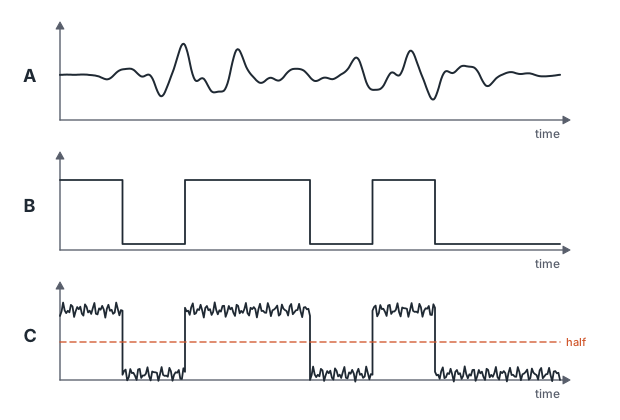
Supplement. The diagram shows three signals, A, B and C. Each graph shows the voltage of a signal against time. Match each signal to its description.
Write the number of the matching option.
- A digital signal
- A digital signal that has picked up noise
- An analogue signal
- Signal A: ______
- Signal B: ______
- Signal C: ______
Nudge (only if you are stuck): How many different values can each signal take? Which one has picked up wiggles on the way?
2. identify
Supplement. Which row describes an analogue signal and a digital signal correctly?
| Row | An analogue signal | A digital signal |
|---|---|---|
| A | has only a few values, usually on and off | varies continuously and can take any value |
| B | varies continuously and can take any value | has only a few values, usually on and off |
| C | travels more slowly along the same fibre | travels faster along the same fibre |
| D | picks up noise along a long cable | picks up no noise along a long cable |
Circle one answer.
- A
- B
- C
- D
Nudge (only if you are stuck): Think of a dial that can be turned to any position, and a button that is either pressed or not.
3. identify
Supplement. Match each signal to its kind.
Write the number of the matching option.
- Digital
- Analogue
- The voltage from a guitar pickup as a string vibrates: ______
- The height of the water in a rain gauge during a storm: ______
- A television remote’s infrared beam, flashed on and off in a pattern: ______
- The voltage on a computer’s data wire, either 0 V or 3.3 V: ______
Nudge (only if you are stuck): Can it take any value, or only a few?
4. explain
Supplement. A signal along a wire can only be 0 V, 1 V, 2 V or 3 V, with nothing in between. A pupil says: “It has more than two values, so it must be analogue.” Explain why the pupil is incorrect.
Why the pupil is incorrect
Nudge (only if you are stuck): Could this voltage ever be 1.5 V?
5. describe
Supplement. A radio presenter’s voice is sent as a digital signal along an optical fibre to a transmitter mast. Put the steps in order.
Write the number of each step in order.
- The voltage is measured thousands of times a second
- A laser flashes the code along the fibre as pulses of light
- At the far end the pulses are turned back into a varying voltage
- The microphone turns the voice into a varying voltage
- Each measurement is turned into a code of 1s and 0s
- Step 1: ______
- Step 2: ______
- Step 3: ______
- Step 4: ______
- Step 5: ______
Nudge (only if you are stuck): Which step can only happen once there is a code to send?
6. explain
Supplement. A pupil says: “A baby’s cry varies smoothly, so it can only be sent as an analogue signal.” An older baby monitor sends a radio wave whose strength rises and falls with the cry. A newer one sends 8 000 codes of 1s and 0s every second, and the parent still hears the cry clearly. Use the two monitors to explain why the pupil is incorrect.
Why the pupil is incorrect
Nudge (only if you are stuck): What could each of the 8 000 codes stand for?
7. complete
Supplement. A long cable beside a railway line has repeaters along it. Complete the sentences. In each stretch of the cable, the signal picks up ____ (1). At each repeater, an analogue signal is ____ (2), noise and all, so the noise grows. A digital signal is ____ (3): each pulse is read as on or off and sent on clean. So a digital signal can be sent over an increased ____ (4).
Gap 1
Gap 2
Gap 3
Gap 4
Nudge (only if you are stuck): What can a repeater do with a signal of only two values that it cannot do with a signal of any value?
8. identify
Supplement. Which two are benefits of sending a signal in digital form?
Tick every correct statement.
- Its pulses move along the link faster than analogue ones
- It can go further, as each repeater rebuilds clean pulses
- Its pulses pick up no noise at all along the whole link
- More data can be sent along the same link each second
Nudge (only if you are stuck): Cross out any option that is untrue of digital signals.
9. identify
Supplement. Two links use the same kind of optical fibre. Link X sends a signal as digital pulses of light. Link Y sends an analogue copy of it, light whose brightness varies smoothly. Link X carries far more data each second. Which is the best explanation?
Circle one answer.
- The pulses travel along the fibre faster than the smoothly varying light of link Y.
- The glass absorbs light whose brightness varies, but lets on-and-off pulses through.
- Each pulse need only be read as on or off, so pulses can be short and close together.
- The pulses pick up no noise at all in the fibre, so no data ever has to be sent twice.
Nudge (only if you are stuck): What does the receiver of each link have to measure at each moment?
10. determine / identify / explain
Supplement. Along a digital cable, one repeater sends on eight pulses at full height, 1.0 for on and 0 for off: off, on, on, off, on, off, on, on. They reach the next repeater with these heights: 0.1, 0.8, 0.45, 0.3, 0.9, 0.55, 1.0, 0.7. The next repeater reads a pulse above 0.5 as on, and any other pulse as off. (a) Match each arriving pulse to what the next repeater sends on. (b) Identify the pulses that are now wrong, and explain why. (c) Determine the largest change in height that the noise made to any pulse.
Write the number of the matching option.
- Off
- On
- Pulse 1, arriving at 0.1: ______
- Pulse 2, arriving at 0.8: ______
- Pulse 3, arriving at 0.45: ______
- Pulse 4, arriving at 0.3: ______
- Pulse 5, arriving at 0.9: ______
- Pulse 6, arriving at 0.55: ______
- Pulse 7, arriving at 1.0: ______
- Pulse 8, arriving at 0.7: ______
(b) The wrong pulses and why, and (c) the largest change in height
Nudge (only if you are stuck): For (a), which side of 0.5 is each height? For (c), what height did each pulse leave with?
11. explain
Supplement. (a) Calls along an old analogue telephone cable, with repeaters along it, arrive with a hiss. A pupil says: “The hiss would go if each repeater amplified the signal more.” Explain why the pupil is incorrect. (b) Another pupil says: “A signal sent as light is digital, and a signal sent as electricity is analogue.” Explain why this is incorrect.
(a) Why the first pupil is incorrect
(b) Why the second pupil is incorrect
Nudge (only if you are stuck): For (a), what reaches each repeater along with the voice? For (b), think of a signal of each kind that breaks the rule.
12. explain / predict / determine
Supplement. Along a digital cable, noise changes the height of each pulse by up to 0.2 of the full height in every 40 km. A repeater reads a pulse above half height as on. An on pulse leaves a repeater at full height, 1.0, and an off pulse at 0. (a) The repeaters are 40 km apart. Explain why every pulse is regenerated right. (b) To save money, an engineer suggests repeaters 120 km apart, where the noise can change a height by up to 0.6. Predict what would happen to the pulses, and explain why. (c) Determine the smallest change in height that could make an on pulse be regenerated as off.
(c) Smallest change that could turn an on pulse off: ______________ unit ________
(a) Repeaters 40 km apart, and (b) repeaters 120 km apart
Nudge (only if you are stuck): Where must each pulse arrive for the repeater to read it right?
13. identify / explain
Supplement. A vinyl record stores music as a wavy groove whose shape copies the sound; a music file stores it as a long list of 1s and 0s. (a) Identify which stores the music as an analogue signal and which as a digital signal. (b) In the 1970s a studio copied a tape of a song, then copied the copy, eight times in all; each copy added a little hiss. Explain why the eighth copy hissed loudly. (c) Today a music file is copied eight times. Explain why the eighth copy sounds exactly like the first.
(a) Analogue and digital
(b) Why the tape hissed
(c) Why the file stays exact
Nudge (only if you are stuck): For (b), what happens to the hiss already on the tape? For (c), what does a copy do with a 1 stored slightly weak?