Pupil sheet · Communicating with waves
Signals around the world — questions
Name ______________________ Date ____________
Try every question before you use a nudge. Write in full sentences where you are asked to explain.
1. identify
A ground station in Scotland sends a television signal up to a satellite. The sky is covered in heavy grey cloud, and the station’s dish aims all of the signal at that one satellite, far above. Which kind of wave does the ground station mainly use?
Circle one answer.
- Radio waves
- Microwaves
- Visible light
- Sound waves
Nudge (only if you are stuck): Cross out any wave that cannot cross empty space, then any wave that the cloud would stop.
2. identify
The diagram shows two artificial satellites, P and Q, and a house with a dish fixed to its wall. Match each satellite, and each description, to the kind of satellite it fits.
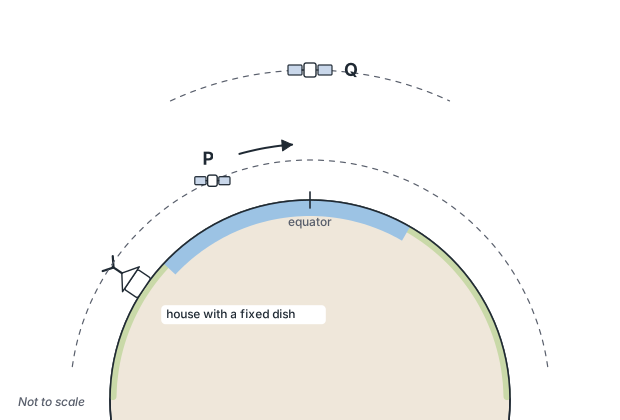
Write the number of the matching option.
- A geostationary satellite
- A low-orbit satellite
- Satellite P: ______
- Satellite Q: ______
- Takes a whole day to go round the Earth once: ______
- Crosses the sky in a few minutes: ______
- The satellite the fixed dish points at: ______
Nudge (only if you are stuck): Which satellite is close to the Earth, and which is high above the equator?
3. identify
Some satellite phones use low-orbit satellites, and some use geostationary satellites. Match each satellite-phone service to the kind of satellite that suits it.
Write the number of the matching option.
- Geostationary satellites
- Low-orbit satellites
- A scientist’s hand-held phone at a camp near the North Pole: ______
- A live video call in which even a quarter-second pause would annoy the callers: ______
- A phone small enough for a pocket, with a weak transmitter and a short aerial: ______
- A service that covers most of the world with only three satellites: ______
Nudge (only if you are stuck): For each one, ask: does it need the satellite close to the Earth, or does it need the satellite to stay in one place?
4. describe
A journalist in Nairobi phones an editor in Singapore. The call goes through a geostationary satellite. Put the steps in order, from the journalist’s voice to the sound the editor hears.
Write the number of each step in order.
- A receiver takes the signal off the microwaves
- The speaker turns the signal back into sound
- A transmitter puts the signal on microwaves and a dish sends them up
- The microphone turns the sound into an electrical signal
- The satellite receives the microwaves and sends them down
- Step 1: ______
- Step 2: ______
- Step 3: ______
- Step 4: ______
- Step 5: ______
Nudge (only if you are stuck): Sound exists only at the two ends. Between them, what carries the signal?
5. predict / explain
A hotel in Quito, Ecuador, has a dish for direct broadcast satellite television bolted to its roof, pointing at a geostationary satellite. Suppose the satellite still went round above the equator, but took 12 hours to go round the Earth instead of one day. Predict what would happen to the hotel’s picture, and explain why.
Circle one answer.
- The picture would be lost: the satellite would be further away, so its signal would be too weak.
- The picture would be lost: the signal would take too long to come down from the satellite.
- The picture would be lost: the satellite would move across the sky, out of the dish’s beam.
- The picture would stay: the satellite would still be above the equator, where the dish points.
Why the picture would be lost, or stay
Nudge (only if you are stuck): Compare the time the satellite would take to go round with the time the Earth takes to turn once.
6. determine / explain
A mountain-rescue team in the Himalaya carries hand-held satellite phones. The phone service uses 66 low-orbit satellites, while a television service covers most of the world with three geostationary satellites. (a) Each low-orbit satellite is in the team’s sky for about 9 minutes, and a rescue call lasts 40 minutes. Determine the smallest number of satellites that carry the call, one after another. (b) Explain why the phone service needs so many low-orbit satellites, when three geostationary satellites can cover most of the world.
(a) Smallest number of satellites: ______________ unit ________
(b) Why so many low-orbit satellites are needed
Nudge (only if you are stuck): For (a), can the number of satellites be a fraction? For (b), compare how high each kind of satellite is, and how long it stays in view.
7. calculate / deduce / explain
Supplement. A message is sent from Mombasa, Kenya, to Mumbai, India, by two routes at the same moment. Route 1 is an undersea cable 4 600 km long, in which light travels at 2.0 × 10⁸ m/s. Route 2 goes up to a low-orbit satellite, along a chain of them and down again: 5 700 km in all, for microwaves at 3.0 × 10⁸ m/s. (a) Calculate the time the message takes on each route. Give your answers to 2 significant figures. (b) Deduce which route delivers the message first, and explain why the length of a route alone does not decide this.
(a) Time by the cable: ______________ unit ________
(a) Time by the satellites: ______________ unit ________
(b) The route that is first, and why
Nudge (only if you are stuck): For (a), check which speed belongs to which route, and change kilometres to metres. For (b), what is different about the two journeys besides their length?
8. identify
Supplement. Match each device to the region of the electromagnetic spectrum it uses.
Write the number of the matching option.
- Radio waves
- Visible light or infrared
- Microwaves
- A smart doorbell on the home wi-fi: ______
- A wireless game controller linked by Bluetooth: ______
- A cable-television optical fibre: ______
- A tablet on the mobile phone network: ______
Nudge (only if you are stuck): One region is used by two of the devices.
9. identify
Supplement. Match each system to the reason its waves suit it.
Write the number of the matching option.
- they cannot pass through walls, so the signal stays private
- they travel faster through the air than waves of other regions
- they get through walls but are weakened, fine for a short link
- they get through some walls, and only need a short aerial
- Mobile phones use microwaves because…: ______
- Wi-fi uses microwaves because…: ______
- Bluetooth uses radio waves because…: ______
Nudge (only if you are stuck): Cross out any option that is untrue of the waves, then match what is left.
10. explain
Supplement. A library has two floors. (a) A tablet upstairs uses the wi-fi router, which is downstairs. Explain why the signal reaches the tablet, and why the tablet’s aerial can fit inside its thin case. (b) A visitor plays music from her phone on a Bluetooth speaker. She leaves the phone on a desk and carries the speaker out of the building and across the car park. Explain why the music cuts out.
(a) Why wi-fi reaches upstairs with a small aerial
(b) Why the music cuts out
Nudge (only if you are stuck): For each, identify the region of the spectrum first, then use its reason.
11. identify
Supplement. A broadband optical-fibre link sends short-wavelength infrared, not ultraviolet. Which is the best reason?
Circle one answer.
- Glass is transparent to some infrared, but it absorbs much ultraviolet.
- Infrared travels faster than ultraviolet, so the data arrives sooner.
- Infrared can pass through walls, so the fibre can run through buildings.
- Ultraviolet has too low a frequency to carry high rates of data.
Nudge (only if you are stuck): What must happen to the waves as they travel many kilometres inside the glass?
12. identify
Supplement. A cable-television company replaces the copper cable into a block of flats with an optical fibre, so that 400 channels and fast broadband can arrive at once. Which row is correct?
| Row | The fibre carries | Why it travels far in the fibre | Why it suits 400 channels |
|---|---|---|---|
| A | microwaves | they can pass through some walls | a short aerial is enough |
| B | infrared | glass is transparent to some infrared | it can carry high rates of data |
| C | infrared | glass is transparent to some infrared | it travels faster than other waves |
| D | an electric current | glass is a good conductor | it can carry high rates of data |
Circle one answer.
- A
- B
- C
- D
Nudge (only if you are stuck): Check one column at a time, and cross out a row as soon as one of its entries is wrong.
13. suggest / calculate / explain
A space station goes round the Earth in a low orbit. Seen from any one ground station, it crosses the sky in a few minutes. (a) The space station’s calls are relayed through a few geostationary satellites, spread round the equator, to a fixed dish at the control room. Suggest why. (b) Supplement. When the space station is straight overhead, a ground station sends a test signal up to it, and the space station sends it straight back down. The trip up and down takes 0.0028 s. Microwaves travel at 3.0 × 10⁸ m/s. Calculate the height of the space station above the ground, in km. (c) Supplement. Engineers test a laser link that sends infrared from the space station to a telescope on the ground. It sends a large video file down far more quickly than the microwave link does, but on some days it does not work at all. Explain why.
(b) Supplement: Height of the space station: ______________ unit ________
(a) Why the calls go through geostationary satellites, and (c) Supplement: why the laser link is quicker but sometimes fails
Nudge (only if you are stuck): For (a), for how long could one ground dish reach the space station? For (b), which distance does the 0.0028 s belong to? For (c), think of what can lie between the space station and the telescope.