Pupil sheet · Momentum and collisions
Impulse and safety — questions
Name ______________________ Date ____________
Try every question before you use a nudge. Write in full sentences where you are asked to explain.
1. define
Which of these is the definition of impulse?
Circle one answer.
- force × time the force acts for
- force × distance the force moves
- force ÷ time the force acts for
- mass × velocity of the object
Nudge (only if you are stuck): Two of these products are other quantities you know: momentum and the work done. Which are they?
2. calculate
A force of 20 N acts on a trolley for 250 ms. Calculate the impulse. Give your answer to 2 significant figures.
Impulse: ______________ unit ________
Nudge (only if you are stuck): What unit must the time be in? Then use impulse = F∆t.
3. identify
Which row gives a correct unit for momentum and a correct unit for impulse?
| Row | Unit of momentum | Unit of impulse |
|---|---|---|
| A | kg m/s | N s |
| B | kg m/s² | N s |
| C | kg m/s | N/s |
| D | N | J |
Circle one answer.
- A
- B
- C
- D
Nudge (only if you are stuck): Build each unit from the quantities that are multiplied in its definition.
4. calculate
A golf club hits a golf ball of mass 46 g that is at rest. The impulse on the ball is 2.3 N s. Calculate the speed at which the ball leaves the club. Give your answer to 2 significant figures.
Speed: ______________ unit ________
Nudge (only if you are stuck): Which change does the impulse equal? What unit must the mass be in?
5. calculate
A 0.40 kg trolley hits a rubber buffer at the end of a track at 1.5 m/s and rebounds straight back at 1.0 m/s. Calculate the size of the change in its momentum. Give your answer to 2 significant figures.
Change in momentum: ______________ unit ________
Nudge (only if you are stuck): Take the velocity towards the buffer as positive. What is the velocity after the rebound?
6. calculate
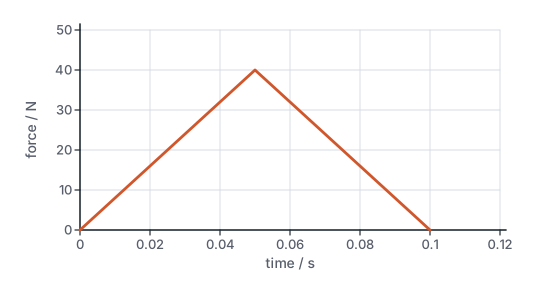
The graph shows how the force on a ball changes while a bat hits it. Calculate the impulse on the ball. Give your answer to 2 significant figures.
Impulse: ______________ unit ________
Nudge (only if you are stuck): What shape is the area under the graph? How do you find the area of that shape?
7. deduce
A toy car hits a brick wall and stops. On a second run, it hits a block of foam at the same speed and stops again. A force sensor records both impacts. The two force–time graphs have the same area, and the impact with the foam lasts longer. Which statement is correct?
Circle one answer.
- The foam gives the bigger impulse, because it presses for longer.
- The impulses are equal, and the wall gives the smaller average force.
- The wall gives the bigger impulse, because its peak force is taller.
- The impulses are equal, and the foam gives the smaller average force.
Nudge (only if you are stuck): What does the area under a force–time graph tell you?
8. define
Which of these defines resultant force in terms of momentum?
Circle one answer.
- change in momentum ÷ time taken
- momentum × time taken
- momentum ÷ mass of the object
- change in momentum × time taken
Nudge (only if you are stuck): Check each option’s unit. A force is measured in newtons, and 1 N = 1 kg m/s².
9. calculate
The momentum of a trolley changes by 12 kg m/s in 0.40 s. Calculate the resultant force on it. Give your answer to 2 significant figures.
Resultant force: ______________ unit ________
Nudge (only if you are stuck): Use F = ∆p ÷ ∆t.
10. calculate
A car of mass 1500 kg speeds up from 8.0 m/s to 20 m/s in 4.0 s. Calculate (a) its change in momentum and (b) the average resultant force on it. Give your answers to 2 significant figures.
(a) Change in momentum: ______________ unit ________
(b) Average resultant force: ______________ unit ________
Nudge (only if you are stuck): The car is moving at the start. What is its momentum before and after?
11. calculate
A phone of mass 0.15 kg falls and hits the ground at 4.0 m/s and stops. Calculate the average resultant force on it if it stops (a) in 3.0 ms on hard tiles and (b) in 40 ms on a thick carpet. Give your answers to 2 significant figures.
(a) Force on the tiles: ______________ unit ________
(b) Force on the carpet: ______________ unit ________
Nudge (only if you are stuck): Is the change in momentum the same both times? What unit must each time be in?
12. deduce
A tennis ball moves to the right towards a player. The player’s racket hits it, and it moves off to the left, faster than before. Which row gives the direction of the change in momentum of the ball and the direction of the force of the racket on it?
| Row | Change in momentum of the ball | Force of the racket on the ball |
|---|---|---|
| A | to the left | to the left |
| B | to the right | to the right |
| C | to the left | to the right |
| D | to the right | to the left |
Circle one answer.
- A
- B
- C
- D
Nudge (only if you are stuck): Take right as positive. Is the momentum after bigger or smaller than the momentum before?
13. deduce
A carpenter can drive a nail with a steel-headed hammer or with a rubber-headed hammer. The two heads have the same mass, hit the nail at the same speed and stop on it. Which row describes the steel head compared with the rubber head?
| Row | Change in momentum of the head | Time to stop | Average force on the nail |
|---|---|---|---|
| A | the same | shorter | bigger |
| B | the same | longer | smaller |
| C | bigger | shorter | bigger |
| D | the same | shorter | smaller |
Circle one answer.
- A
- B
- C
- D
Nudge (only if you are stuck): Does a steel head squash as it stops? What does that do to the stopping time?
14. calculate
A resultant force of 4.0 N acts on a 2.0 kg trolley, at rest, for 3.0 s. Calculate (a) its change in momentum and (b) its velocity at the end. Give your answers to 2 significant figures.
(a) Change in momentum: ______________ unit ________
(b) Velocity: ______________ unit ________
Nudge (only if you are stuck): Which quantity equals F∆t? Then which equation links momentum, mass and velocity?
15. calculate
A car of mass 900 kg moving at 12 m/s is stopped by an average braking force of 5000 N. Calculate how long it takes to stop. Give your answer to 2 significant figures.
Stopping time: ______________ unit ________
Nudge (only if you are stuck): Rearrange F = ∆p ÷ ∆t to make ∆t the subject.
16. calculate
An ice-hockey puck of mass 160 g slides at 9.0 m/s straight into the board at the side of the rink. It bounces straight back at 6.0 m/s. It is in contact with the board for 20 ms. Calculate the average force of the board on the puck. Give your answer to 2 significant figures.
Average force: ______________ unit ________
Nudge (only if you are stuck): Does the puck only stop, or is it sent back too? What units must the mass and the time be in?
17. calculate / explain
A fielder catches a 0.16 kg cricket ball moving at 30 m/s. (a) Calculate the change in momentum of the ball as it stops. (b) With stiff hands, the ball stops in 0.016 s. Calculate the average force on the ball. (c) A skilled fielder lets the hands move back with the ball, so it stops in 0.12 s. Calculate the average force now. (d) Explain, using impulse, why the change in momentum is the same in both catches. (e) The force–time graph of a catch rises to a peak and falls back. Explain why the peak force on the ball is bigger than your answer to (c).
(a) Change in momentum
(b) Force, stiff hands
(c) Force, hands moving back
(d) Why the same change
(e) Peak and average
Nudge (only if you are stuck): The ball stops from 30 m/s both times. Which equation links force, change in momentum and time?