Pupil sheet · Momentum and collisions
Momentum — questions
Name ______________________ Date ____________
Try every question before you use a nudge. Write in full sentences where you are asked to explain.
1. define
Which of these is the definition of momentum?
Circle one answer.
- mass × acceleration
- mass × velocity
- force × distance
- mass ÷ velocity
Nudge (only if you are stuck): Two of these products are other quantities you know: the resultant force and the work done. Which are they?
2. calculate
A trolley of mass 0.80 kg moves at 2.5 m/s. Calculate its momentum. Give your answer to 2 significant figures.
Momentum: ______________ unit ________
Nudge (only if you are stuck): Use p = mv, with the mass in kg and the velocity in m/s.
3. calculate
A loaded shopping trolley rolls at 1.5 m/s. Its momentum is 54 kg m/s. Calculate its mass. Give your answer to 2 significant figures.
Mass: ______________ unit ________
Nudge (only if you are stuck): Rearrange p = mv so that m is on its own.
4. calculate
On smooth ice, a skater of mass 60 kg glides at 4.0 m/s. She catches up with a skater of mass 40 kg who is gliding at 1.5 m/s in the same direction. They hold on to each other and move off together. Calculate their velocity just after they join. Give your answer to 2 significant figures.
Velocity after: ______________ unit ________
Nudge (only if you are stuck): Both skaters move the same way. What sign does each momentum have?
5. calculate
A baseball of mass 145 g has a momentum of 5.8 kg m/s. Calculate its speed. Give your answer to 2 significant figures.
Speed: ______________ unit ________
Nudge (only if you are stuck): What unit must the mass be in? Then rearrange p = mv.
6. deduce
A 2.0 kg trolley moves to the right at 1.5 m/s. A 3.0 kg trolley moves to the left at 1.0 m/s. Which statement about their momenta is true?
Circle one answer.
- Their momenta are equal in size and opposite in direction.
- The 3.0 kg trolley has more momentum, because it is heavier.
- The 2.0 kg trolley has more momentum, because it is faster.
- They have the same momentum, +3.0 kg m/s each.
Nudge (only if you are stuck): Work out mass × velocity for each trolley, with right as positive.
7. calculate
A 1.2 kg trolley moves to the left at 0.50 m/s. Taking velocity to the right as positive, calculate the momentum of the trolley. Include the sign.
Momentum: ______________ unit ________
Nudge (only if you are stuck): Which way does the trolley move? What sign does that give its velocity?
8. deduce
Two trolleys, A and B, collide on a level track. No resultant force from outside acts on them. During the collision, the momentum of A falls by 0.36 kg m/s. What happens to the momentum of B?
Circle one answer.
- It rises by less than 0.36 kg m/s.
- It rises by 0.36 kg m/s.
- It stays the same.
- It falls by 0.36 kg m/s.
Nudge (only if you are stuck): What must happen to the total momentum of A and B together?
9. calculate
A 1.5 kg trolley moving at 4.0 m/s hits a 0.50 kg trolley at rest. They stick together. Calculate their velocity just after the collision. Give your answer to 2 significant figures.
Velocity after: ______________ unit ________
Nudge (only if you are stuck): Find the total momentum before. After the collision, what mass moves with the one velocity?
10. calculate
The diagram shows two trolleys about to collide head-on. (a) Calculate their total momentum before the collision. (b) After the collision, Q moves to the right at 1.2 m/s. Calculate the velocity of P after the collision, and give its direction.
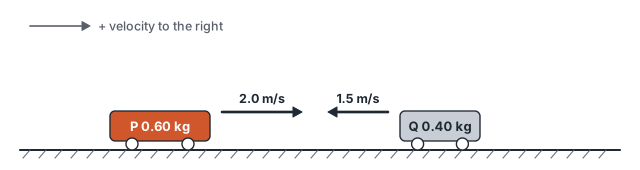
(a) Total momentum before: ______________ unit ________
(b) Velocity of P after (to the right is positive): ______________ unit ________
Nudge (only if you are stuck): Which way does Q move before the collision? What sign does that give its velocity?
11. calculate
A 0.25 kg trolley moving at 2.4 m/s to the right hits a 0.50 kg trolley at rest. The 0.25 kg trolley bounces back to the left at 0.40 m/s. Calculate the velocity of the 0.50 kg trolley after the collision. Give your answer to 2 significant figures.
Velocity of the 0.50 kg trolley: ______________ unit ________
Nudge (only if you are stuck): Which way does the 0.25 kg trolley move after the collision? What sign does that give its velocity?
12. calculate
Two trolleys are held at rest with a squashed spring between them. When it is released, Y moves off to the right at 0.30 m/s. Calculate the velocity of X. Include the sign.
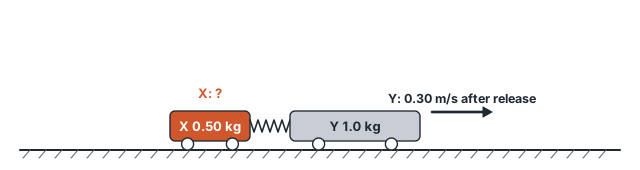
Velocity of X: ______________ unit ________
Nudge (only if you are stuck): What is the total momentum before the spring is released?
13. calculate
A rifle of mass 4.0 kg fires a bullet of mass 10 g at 400 m/s. Calculate the speed at which the rifle recoils. Give your answer to 2 significant figures.
Recoil speed: ______________ unit ________
Nudge (only if you are stuck): What is the total momentum before the rifle fires? What unit must the bullet’s mass be in?
14. explain
A bag of sand falls and lands on the ground without bouncing. Its downward momentum seems to vanish. Which explanation is correct?
Circle one answer.
- The ground pushes up from outside, and the momentum passes to the Earth.
- The bag’s momentum changes into heat and sound as it hits the ground.
- The bag had no momentum, because it started falling from rest.
- Momentum is destroyed when the bag stops, so it is not conserved here.
Nudge (only if you are stuck): While the bag stops, is there a force on it from something outside it?
15. identify
A 2.0 kg trolley moving to the right at 3.0 m/s catches up with a 1.0 kg trolley moving to the right at 1.5 m/s. They stick together. The table shows a pupil’s working. Which step is wrong?
| Step | Working |
|---|---|
| 1 | Take right as positive. |
| 2 | Total momentum before = 2.0 × 3.0 − 1.0 × 1.5 = 4.5 kg m/s |
| 3 | Total momentum after = (2.0 + 1.0) × v = 3.0 v |
| 4 | 3.0 v = 4.5, so v = 1.5 m/s |
Circle one answer.
- Step 1
- Step 2
- Step 3
- Step 4
Nudge (only if you are stuck): Check each step’s signs: which way does each trolley move?
16. state / calculate / explain
An astronaut floats at rest outside a space station, with no rope attached. The astronaut and suit have a mass of 125 kg. To get back, the astronaut throws a 2.5 kg spanner straight away from the station at 4.0 m/s. (a) State the total momentum of the astronaut and the spanner before the throw. (b) Calculate the momentum of the spanner after the throw. (c) Calculate the velocity of the astronaut after the throw, and give its direction. (d) Explain why throwing the spanner away from the station sends the astronaut towards it.
(a) Total momentum before
(b) Momentum of the spanner
(c) Velocity of the astronaut
(d) Explanation
Nudge (only if you are stuck): Before the throw, nothing moves. With no resultant force from outside, what happens to the total?