Pupil sheet · Rates of reaction
Why collisions matter — questions
Name ______________________ Date ____________
Try every question before you use a nudge. Write in full sentences where you are asked to explain.
1. identify
Supplement. What must happen for two particles to react?
Circle one answer.
- They must collide head-on, whatever their energy
- They must collide with a particle of a catalyst
- They must collide with at least the activation energy
- They must collide with at least the energy of the products
Nudge (only if you are stuck): Not every collision works.
2. explain
Supplement. Match each change to the best collision-theory explanation of why it speeds up a reaction.
Write the number of the matching option.
- A lower activation energy, so more of the collisions succeed
- Particles move faster: more frequent collisions, and more of them have at least Ea
- More particles exposed on the surface, so collisions are more frequent
- More particles per unit volume, so collisions are more frequent
- 1. More concentrated acid: ______
- 2. Powder instead of lumps: ______
- 3. A higher temperature: ______
- 4. A catalyst: ______
- 5. A higher pressure of reacting gases: ______
Nudge (only if you are stuck): Three of them give more collisions each second; temperature does that and more.
3. explain
Supplement. An indigestion tablet fizzes faster in water at 45 °C than in water at 15 °C. Explain, using collision theory, why. Give two reasons.
Reason 1
Reason 2
Nudge (only if you are stuck): Think about how often the particles collide, and how hard.
4. identify
Supplement. The diagram shows one reaction by two routes, P and Q, on an energy scale. One route is with a catalyst and the other without. Which row gives the route with the catalyst, its activation energy and ΔH?
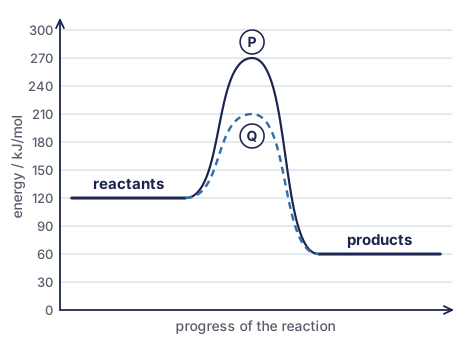
| Row | Route with the catalyst | Ea of that route / kJ/mol | ΔH / kJ/mol |
|---|---|---|---|
| A | Q | 90 | −60 |
| B | Q | 210 | −60 |
| C | P | 150 | −60 |
| D | Q | 90 | +60 |
Circle one answer.
- A
- B
- C
- D
Nudge (only if you are stuck): Which part of the pathway diagram does a catalyst move, and which parts stay put?
5. explain
Supplement. Sulfur dioxide and oxygen are gases that react together. The gas mixture is squeezed into a smaller volume at the same temperature, and the rate goes up. Which row explains why?
| Row | Particles per unit volume | Collisions each second | Share of collisions with at least Ea |
|---|---|---|---|
| A | more | more | the same |
| B | more | more | larger |
| C | the same | more | larger |
| D | the same | the same | larger |
Circle one answer.
- A
- B
- C
- D
Nudge (only if you are stuck): Which of the four collision-theory ideas does squeezing a gas change?
6. identify / explain
An iron nail held in a Bunsen flame glows but does not burn. A pad of steel wool (very thin strands of steel, which is mostly iron) held in the same flame burns with bright sparks. (a) Identify the factor that makes the steel wool burn so much faster. (b) Supplement. Explain the difference using collision theory. (c) Supplement. Steel wool does not burn in the air of the room until it is held in the flame. Explain why, using activation energy.
(a) The factor
(b) Supplement: collision theory
(c) Supplement: why the flame
Nudge (only if you are stuck): For (c): what must a collision have before particles can react?