Pupil sheet · Rates of reaction
The gas syringe race — questions
Name ______________________ Date ____________
Try every question before you use a nudge. Write in full sentences where you are asked to explain.
1. determine / describe
Iron filings react with dilute hydrochloric acid in a flask, and the hydrogen is collected in a gas syringe. The table shows the volume of gas in the syringe. (a) Determine the volume of hydrogen collected in the first 30 s. (b) Determine the volume collected between 30 s and 60 s. (c) Describe what your answers show about the rate of the reaction.
| Time / s | 0 | 30 | 60 | 90 | 120 | 150 | 180 |
|---|---|---|---|---|---|---|---|
| Volume of hydrogen / cm³ | 0 | 33 | 54 | 66 | 72 | 74 | 74 |
(a) Hydrogen in the first 30 s: ______________ unit ________
(b) Hydrogen from 30 s to 60 s: ______________ unit ________
(c) What your answers show about the rate.
Nudge (only if you are stuck): For (b), find how much the volume rose between the two readings.
2. determine / calculate
Use curve A on the graph. (a) Determine the total volume of gas made in reaction A. (b) Determine the volume of gas in reaction A at 30 s. (c) Calculate the average rate of reaction A over the first 30 s. Use your answer to (b).
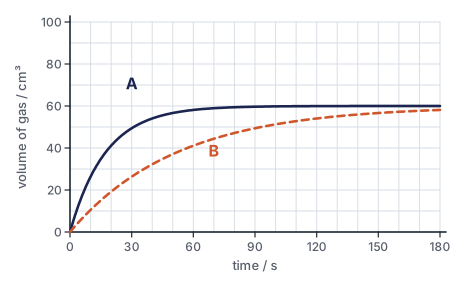
(a) Total volume of gas in A: ______________ unit ________
(b) Volume in A at 30 s: ______________ unit ________
(c) Average rate over the first 30 s: ______________ unit ________
Nudge (only if you are stuck): For (a), find where curve A goes flat. For (b), go up the 30 s gridline until you meet curve A.
3. identify
Match each part of a volume–time graph for a gas-collecting experiment to what it tells you.
Write the number of the matching option.
- The reaction slows down as a reactant is used up
- The total volume of gas made
- The reaction is fastest
- The reaction has stopped
- 1. The curve is steep at the start: ______
- 2. The curve gets less steep: ______
- 3. The curve is flat: ______
- 4. The height of the flat part: ______
Nudge (only if you are stuck): Steep means a lot of gas each second.
4. deduce / evaluate
Supplement. Four pupils follow reactions that make a gas. Each result shows a weak point of the method. Match each result to its most likely cause.
Write the number of the matching option.
- Too much gas for the syringe to hold
- Gas escaped before the bung went in
- Acid spray left the flask
- The gas is too light to weigh
- The plunger stuck, then jumped
- 1. Gas syringe: the readings are 0, 22, 22, 22, then 41 cm³: ______
- 2. Gas syringe: the plunger reaches 100 cm³ while the mixture still fizzes: ______
- 3. Balance reading to 0.01 g: magnesium fizzes in acid, but the mass falls by only 0.01 g: ______
- 4. Balance: more mass is lost than the gas can explain, and acid drops are on the bench: ______
Nudge (only if you are stuck): For each result, ask what went wrong: the reading, the space for the gas, or something leaving the flask.
5. deduce
0.05 g of magnesium ribbon reacts with excess dilute hydrochloric acid, and 49 cm³ of hydrogen is collected. The experiment is repeated with 0.05 g of magnesium powder and the same acid. Deduce how the powder's curve compares with the ribbon's curve.
Circle one answer.
- Steeper at the start; it levels off above 49 cm³
- Steeper at the start; it levels off at 49 cm³, sooner
- Less steep at the start; it levels off above 49 cm³
- As steep at the start; it levels off at 49 cm³, sooner
Nudge (only if you are stuck): Which reactant is used up here, and is there any more of it in the second run?
6. identify
Curves A and B show the same reaction, with the same amounts of reactants, done under two different conditions. Which statement is correct?
Circle one answer.
- A makes more gas in the end, because it is higher at 60 s
- B makes less gas in the end, because its curve is lower
- A is faster at the start; B is still going and is heading for the same volume
- B is faster, because it keeps going for longer
Nudge (only if you are stuck): Compare the gradients at the start, then the volumes the curves are heading for.
7. calculate / explain
A flask of magnesium carbonate lumps and dilute hydrochloric acid stands on a balance, with cotton wool in its neck. The balance reads 124.85 g at the start, 123.94 g after 40 s and 123.47 g at the end. (a) Calculate the mass lost in the first 40 s. (b) Calculate the average rate over the first 40 s, in g/s. Give your answer to 2 significant figures. (c) Explain why the mass goes down.
(a) Mass lost in 40 s: ______________ unit ________
(b) Rate over 40 s: ______________ unit ________
(c) Why the mass goes down.
Nudge (only if you are stuck): For (b), a rate here is the mass lost each second.
8. predict
Excess iron filings react with 30 cm³ of dilute hydrochloric acid, and the hydrogen is collected. The experiment is repeated with the same mass of iron filings and 15 cm³ of hydrochloric acid that is twice as concentrated. Predict the second curve compared with the first. Which row is correct?
| Row | Gradient at the start | Final volume of hydrogen |
|---|---|---|
| A | steeper | the same |
| B | steeper | twice as much |
| C | steeper | half as much |
| D | the same | half as much |
Circle one answer.
- A
- B
- C
- D
Nudge (only if you are stuck): Find the amount of acid in each run: think about its volume and its concentration together.
9. describe / explain / give
A pupil wants to follow the rate of the reaction between magnesium ribbon and dilute hydrochloric acid. The gas made is hydrogen. (a) Describe how she could measure the volume of hydrogen made every 10 s. (b) She plots the volume against time. Explain how her graph will show when the reaction has stopped. (c) Supplement. Explain why following the loss of mass would work badly for this reaction. (d) Supplement. Give one way the gas syringe method could give a reading that is too low.
(a) Measuring the hydrogen
(b) When it has stopped
(c) Supplement: why loss of mass works badly
(d) Supplement: a low reading
Nudge (only if you are stuck): For (c): hydrogen is the lightest gas there is.