Pupil sheet · Isotopes
Why is chlorine 35.5? — questions
Name ______________________ Date ____________
Try every question before you use a nudge. Write in full sentences where you are asked to explain.
1. calculate
Boron has two isotopes. Calculate the relative atomic mass of boron. Give your answer to one decimal place.
| Isotope | Mass number | Abundance (%) |
|---|---|---|
| boron-10 | 10 | 20 |
| boron-11 | 11 | 80 |
Relative atomic mass, Ar: ______________ unit ________
Nudge (only if you are stuck): Multiply each mass number by its abundance, add the two results, then divide by 100.
2. calculate
Lithium has two isotopes. Calculate the relative atomic mass of lithium. Give your answer to one decimal place.
| Isotope | Mass number | Abundance (%) |
|---|---|---|
| lithium-6 | 6 | 7.5 |
| lithium-7 | 7 | 92.5 |
Relative atomic mass, Ar: ______________ unit ________
Nudge (only if you are stuck): Which isotope is far more common? Your answer should be close to it.
3. deduce
Element X has two isotopes: X-63, with an abundance of 69 %, and X-65, with an abundance of 31 %. Without a full calculation, which value is the relative atomic mass of X?
Circle one answer.
- 64.4
- 63.6
- 63.0
- 64.0
Explain your choice without a full calculation.
Nudge (only if you are stuck): Ar lies between the isotopes. Which isotope is it nearer?
4. explain
The Periodic Table gives chlorine a relative atomic mass of 35.5. Chlorine is 75 % chlorine-35 and 25 % chlorine-37. (a) Explain why no chlorine atom has a mass of 35.5. (b) Explain why the relative atomic mass is 35.5 and not 36.
(a) Why no atom has a mass of 35.5
(b) Why 35.5 and not 36
Nudge (only if you are stuck): What is 35.5 the average of? Are both isotopes equally common?
5. calculate
The bar chart shows the isotopes of neon and their abundances. Calculate the relative atomic mass of neon. Give your answer to one decimal place.
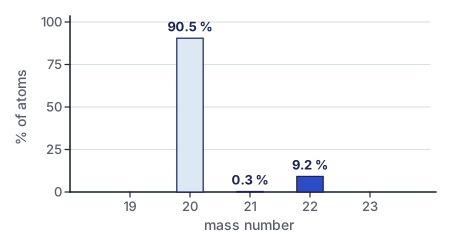
Relative atomic mass, Ar: ______________ unit ________
Nudge (only if you are stuck): Read the mass number and the abundance of each bar. There are three isotopes, so there are three products.