Pupil sheet · Isotopes
Two waters — questions
Name ______________________ Date ____________
Try every question before you use a nudge. Write in full sentences where you are asked to explain.
1. identify
Which pair of atoms are isotopes of the same element?
Circle one answer.
- Atom 1: 6 protons + 6 neutrons; atom 2: 6 protons + 6 neutrons
- Atom 1: 6 protons + 6 neutrons; atom 2: 7 protons + 6 neutrons
- Atom 1: 6 protons + 6 neutrons; atom 2: 6 protons + 8 neutrons
- Atom 1: 6 protons + 8 neutrons; atom 2: 7 protons + 7 neutrons
Nudge (only if you are stuck): Isotopes are the same element, so look for the same number of protons first. Then check the neutrons.
2. deduce
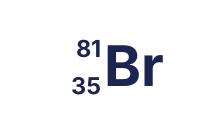
The symbol shows an atom of bromine-81. Deduce the numbers of protons, neutrons and electrons in the atom.
Protons: ______________ unit ________
Neutrons: ______________ unit ________
Electrons: ______________ unit ________
Nudge (only if you are stuck): The bottom number is the proton number. Subtract it from the top number to find the neutrons.
3. deduce
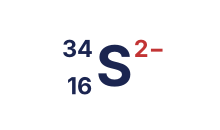
The symbol shows an ion of sulfur-34. Deduce the numbers of protons, neutrons and electrons in the ion.
Protons: ______________ unit ________
Neutrons: ______________ unit ________
Electrons: ______________ unit ________
Nudge (only if you are stuck): The charge is protons − electrons. Does a 2− charge mean more or fewer electrons than protons?
4. identify
Match each particle to its symbol. Magnesium has proton number 12 and sodium 11.
Write the number of the matching option.
- 2411Na
- 2412Mg2+
- 2612Mg
- 2412Mg
- 2612Mg2+
- ²²12Mg
- 12 protons, 12 neutrons, 12 electrons: ______
- 12 protons, 14 neutrons, 12 electrons: ______
- 12 protons, 12 neutrons, 10 electrons: ______
- 11 protons, 13 neutrons, 11 electrons: ______
Nudge (only if you are stuck): Find the element from the protons, the mass number from protons + neutrons, and the charge from protons − electrons.
5. state / explain
Hydrogen has three isotopes: hydrogen-1, hydrogen-2 and hydrogen-3. (a) State the numbers of protons, neutrons and electrons in an atom of each. (b) Write the symbol of hydrogen-2, with its mass number and proton number. (c) Explain why all three are atoms of hydrogen.
(a) Protons, neutrons and electrons in each isotope
(b) The symbol of hydrogen-2 (you may type it in words: the letter, the mass number and the proton number)
(c) Why all three are hydrogen
Nudge (only if you are stuck): Every hydrogen atom has proton number 1. What does the number after the name tell you?
6. explain
(Supplement) Chlorine-35 and chlorine-37 both react with sodium to form sodium chloride. (a) Give the electronic configuration of an atom of each isotope. (b) Explain why both isotopes react with sodium in the same way.
(a) The electronic configuration of each isotope
(b) Why they react the same way
Nudge (only if you are stuck): Chlorine has 17 protons. How many electrons does each atom have, and which particles take part in a reaction?
7. identify
(Supplement) Bottle A holds ordinary water and bottle B heavy water, whose hydrogen atoms are hydrogen-2. Which of these measurements could tell the two liquids apart? Select all that apply. Then explain why the copper(II) sulfate test could not.
Tick every correct statement.
- The colour of anhydrous copper(II) sulfate after a few drops are added
- The colour of each liquid
- The mass of 10 cm³ of each liquid
- The number of hydrogen atoms in each molecule
- The boiling point of each liquid
Why does the copper(II) sulfate test give the same result for both liquids?
Nudge (only if you are stuck): Isotopes differ in mass but react in the same way. Which measurements depend on mass?
8. state / explain
Carbon has three isotopes: ¹²6C, ¹³6C and 146C. (a) State the number of neutrons in an atom of each. (b) (Supplement) A pupil says that carbon-14 burns in oxygen to make a different gas from carbon-12, because its atoms are heavier. Explain whether they are right. (c) Name one property that is different for carbon-12 and carbon-14.
(a) Neutrons in each isotope
(b) Is the pupil right? Explain
(c) A property that differs
Nudge (only if you are stuck): Compare the protons, electrons and neutrons of the isotopes. Which of these decides how carbon burns?