Pupil sheet · Ions and ionic bonding
Dots and crosses — questions
Name ______________________ Date ____________
Try every question before you use a nudge. Write in full sentences where you are asked to explain.
1. identify
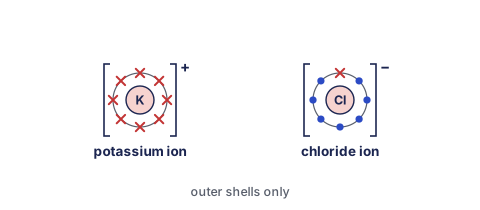
The diagram shows potassium chloride, outer shells only. One atom’s electrons are drawn as dots and the other atom’s as crosses. Which statement about the crosses is correct?
Circle one answer.
- They are protons, and they give the potassium ion its positive charge
- They are shared by both ions, and they hold the two ions together
- They were chlorine’s electrons, and one of them has moved to potassium
- They were potassium’s electrons, and one of them has moved to chlorine
Nudge (only if you are stuck): Use the charges: which atom lost an electron, and which gained one? Then compare the two ions’ outer shells.
2. deduce
A dot-and-cross diagram, outer shells only, shows the ions of a compound of metal M and non-metal X. M’s electrons are crosses and X’s are dots. The ion [M]+ has an outer shell of 8 crosses. The ion [X]− has an outer shell of 7 dots and 1 cross. Which row is correct for the atoms of M and X before they reacted?
| Row | Outer electrons in an M atom | Outer electrons in an X atom | Groups of M and X |
|---|---|---|---|
| A | 8 | 7 | VIII and VII |
| B | 1 | 7 | I and VII |
| C | 1 | 8 | I and VIII |
| D | 8 | 8 | VIII and VIII |
Circle one answer.
- A
- B
- C
- D
Nudge (only if you are stuck): In each ion, which electrons did the atom have before the reaction, and which one moved?
3. deduce
In a dot-and-cross diagram of potassium fluoride, potassium’s electrons are crosses and fluorine’s are dots. Potassium is 2,8,8,1 and fluorine is 2,7. Deduce the number of dots and the number of crosses in the outer shell of the fluoride ion, and the number of crosses in the outer shell of the potassium ion.
Dots in the fluoride ion’s outer shell: ______________ unit ________
Crosses in the fluoride ion’s outer shell: ______________ unit ________
Crosses in the potassium ion’s outer shell: ______________ unit ________
Nudge (only if you are stuck): Which of the fluoride ion’s outer electrons were fluorine’s own, and which one moved across? For potassium, which shell is the outer one once the electron has gone?
4. identify
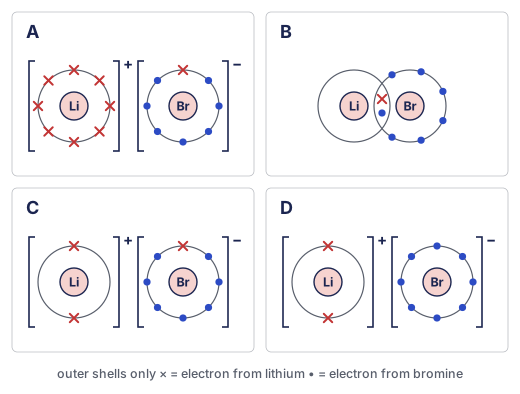
Lithium is in Group I and bromine is in Group VII. The diagrams A–D are drawn for lithium bromide, outer shells only. Lithium’s electrons are crosses and bromine’s are dots. Identify the correct dot-and-cross diagram.
Circle one answer.
- A
- B
- C
- D
Nudge (only if you are stuck): Check three things in each diagram: how many electrons lithium has left, how the moved electron is drawn, and whether the particles are separate ions.
5. deduce
Supplement. Potassium (2,8,8,1) reacts with sulfur (2,8,6) to form potassium sulfide. Deduce the number of electrons each potassium atom loses and the number each sulfur atom gains.
Electrons lost by each potassium atom: ______________ unit ________
Electrons gained by each sulfur atom: ______________ unit ________
Nudge (only if you are stuck): Which element is the metal? Look at the last number in each arrangement.
6. identify
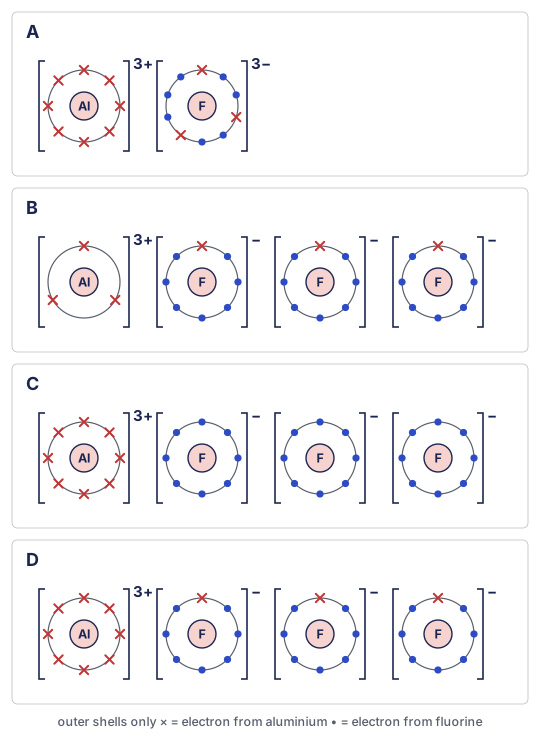
Supplement. Aluminium is 2,8,3 and fluorine is 2,7. The diagrams A–D are drawn for aluminium fluoride, outer shells only. Aluminium’s electrons are crosses and fluorine’s are dots. Identify the correct dot-and-cross diagram.
Circle one answer.
- A
- B
- C
- D
Nudge (only if you are stuck): Start from the atoms: how many electrons does one aluminium atom lose, and how many can one fluorine atom take?
7. determine
Supplement. Aluminium (2,8,3) reacts with oxygen (2,6) to form aluminium oxide. Determine the smallest numbers of aluminium ions and oxide ions in which the electrons lost equal the electrons gained, and the total number of electrons that move.
Aluminium ions: ______________ unit ________
Oxide ions: ______________ unit ________
Electrons moved in total: ______________ unit ________
Nudge (only if you are stuck): Find each ion’s charge first. How many aluminium atoms and how many oxygen atoms make the electrons come out even?
8. deduce
Supplement. Barium is in Group II and fluorine is in Group VII. A pupil draws a dot-and-cross diagram of barium fluoride, outer shells only, with barium’s electrons as crosses and fluorine’s as dots. Which row describes the diagram correctly?
| Row | Charge on the barium ion | Fluoride ions for each barium ion | Outer shell of each fluoride ion |
|---|---|---|---|
| A | 1+ | 1 | 7 dots and 1 cross |
| B | 2+ | 1 | 6 dots and 2 crosses |
| C | 2+ | 2 | 7 dots and 1 cross |
| D | 2+ | 2 | 8 dots |
Circle one answer.
- A
- B
- C
- D
Nudge (only if you are stuck): How many electrons does a barium atom lose, and how many can one fluorine atom take?
9. predict / explain / determine / show
(a) Caesium is in Group I and iodine is in Group VII. Predict the charges on the ions in caesium iodide and the ratio of the ions, and explain the ratio. (b) Supplement: lithium reacts with nitrogen gas even at room temperature, forming lithium nitride. Lithium is in Group I and nitrogen is 2,5. Determine the charges on the two ions and the number of lithium ions for each nitride ion, and show that the electrons lost equal the electrons gained.
(a) Caesium iodide
(b) Supplement: lithium nitride
Nudge (only if you are stuck): You do not need the full arrangements: the Group tells you the outer electrons. For (b), compare what one lithium atom can give with what one nitrogen atom needs.