Pupil sheet · Ions and ionic bonding
Salt and the bulb — questions
Name ______________________ Date ____________
Try every question before you use a nudge. Write in full sentences where you are asked to explain.
1. identify
A pupil tests lithium chloride, an ionic compound, with a bulb tester. Which samples light the bulb? Choose all that apply.
Tick every correct statement.
- Dry crystals of lithium chloride
- Lithium chloride ground to a dry powder
- Lithium chloride heated until molten
- Lithium chloride dissolved in water
Nudge (only if you are stuck): For each sample, ask: are the ions held in place, or can they move?
2. describe
A potassium atom has 19 protons and 19 electrons, arranged 2,8,8,1. Which describes how it forms a potassium ion?
Circle one answer.
- It loses 1 electron and becomes K−, arranged 2,8,8
- It gains 7 electrons and becomes K7−, arranged 2,8,8,8
- It gains 1 proton and becomes K+, arranged 2,8,8,1
- It loses 1 electron and becomes K+, arranged 2,8,8
Nudge (only if you are stuck): Only electrons move when an ion forms. After the change, compare the number of protons with the number of electrons.
3. state
Which statement describes an ionic bond?
Circle one answer.
- A pair of electrons shared between two oppositely charged ions
- A weak electrostatic attraction between oppositely charged ions
- The electron transfer that turns two atoms into oppositely charged ions
- A strong electrostatic attraction between oppositely charged ions
Nudge (only if you are stuck): Think of a crystal of salt: what keeps the ions in place once they have formed?
4. identify
Each particle below is described by its numbers of protons and electrons. Identify each one as a cation, an anion or an atom with no charge.
Write the number of the matching option.
- Cation
- Anion
- Atom with no charge
- 13 protons, 10 electrons: ______
- 9 protons, 10 electrons: ______
- 10 protons, 10 electrons: ______
- 20 protons, 18 electrons: ______
- 8 protons, 10 electrons: ______
Nudge (only if you are stuck): Protons are positive and electrons are negative. Which is there more of in each particle?
5. determine / deduce / explain
Particle Z has 16 protons and 18 electrons. (a) Determine the charge on Z, and state whether Z is a cation or an anion. (b) Deduce how many electrons the atom gained to form Z, and identify the element (use the Periodic Table). (c) A pupil writes: "In an ionic compound of Z, the metal atom and Z share a pair of electrons, and this shared pair is the ionic bond." Explain why the pupil is incorrect.
(a) The charge, and cation or anion
(b) Electrons gained, and the element
(c) Why the pupil is incorrect
Nudge (only if you are stuck): Start from the atom: an atom has no charge. For (c), think about what happens to the electrons when a metal reacts with a non-metal.
6. identify / give
The table gives data for four solids, W, X, Y and Z. (a) Identify the ionic compound. (b) Give two pieces of evidence from the table.
| Solid | Melting point (°C) | Conducts as a solid? | Conducts when molten? |
|---|---|---|---|
| W | 1085 | yes | yes |
| X | 770 | no | yes |
| Y | 80 | no | no |
| Z | 1710 | no | no |
(a) The ionic compound
(b) Two pieces of evidence
Nudge (only if you are stuck): Find a high melting point, then look at how the solid and the liquid conduct.
7. identify
Supplement. The diagram shows one layer of ions in a crystal of magnesium oxide. Which two statements are true for the whole crystal? Choose two.
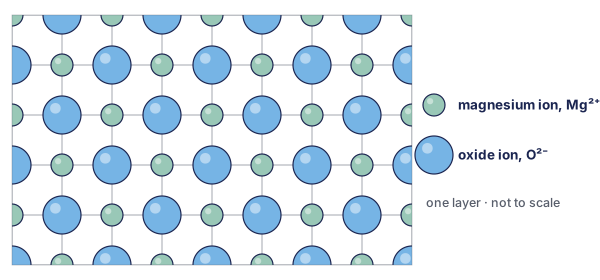
Tick every correct statement.
- Along each diagonal of the diagram, positive and negative ions take turns
- Each magnesium ion is held by just one oxide ion, its partner
- The same pattern carries on far past the edges of the diagram
- Along each row of ions, positive and negative ions take turns
Nudge (only if you are stuck): Trace one row of ions, then one diagonal, ion by ion. Then ask: does the crystal stop where the drawing stops?
8. explain
Supplement. A teacher heats solid lead(II) bromide, an ionic compound, in a fume cupboard. Two carbon rods in it are connected to a bulb and a battery. The bulb stays dark until the solid melts at 373 °C, and then it lights. Which statement explains this?
Circle one answer.
- In the solid the ions are held in place; in the melt they are free to move
- In the solid the ions are large; in the melt they are smaller and slip past
- In the solid there are no ions; in the melt the atoms have become ions
- In the solid the electrons are held; in the melt free electrons carry charge
Nudge (only if you are stuck): A current needs charged particles that can move. Which particles are in lead(II) bromide, solid or molten?
9. describe / explain
Supplement. Calcium oxide is an ionic compound of Ca2+ and O2− ions. It is used to line furnaces because it melts only at 2613 °C. (a) Describe the structure of solid calcium oxide. (b) Explain, in terms of structure and bonding, why its melting point is so high.
(a) The structure
(b) Why the melting point is high
Nudge (only if you are stuck): For (a), how are the two kinds of ion arranged? For (b), what holds each ion in place, and in how many directions?
10. predict / describe / explain
Some toothpastes for sensitive teeth contain strontium chloride, an ionic compound. Strontium is in Group II. A pupil tests the compound with a bulb tester: the dry crystals leave the bulb dark, a solution in pure water lights it, and pure water on its own leaves it dark. (a) Predict the charge on a strontium ion, and describe how a strontium atom forms it. (b) The pupil says, "The solution conducts because of the water." Use the results to explain why the pupil is incorrect. (c) A second pupil says, "In the crystal, each strontium ion is held only by the chloride ions that took its electrons." Explain why this is incorrect. (d) Supplement: explain why the dry crystals do not conduct, while the solution does.
(a) The charge, and how the ion forms
(b) Why the first pupil is incorrect
(c) Why the second pupil is incorrect
(d) Supplement: crystals and solution
Nudge (only if you are stuck): Use the Group number for (a). For (b), look at the pure-water result. For (c), think about all the ions around one strontium ion in the crystal.