Pupil sheet · Giant structures
Diamond and graphite — questions
Name ______________________ Date ____________
Try every question before you use a nudge. Write in full sentences where you are asked to explain.
1. state
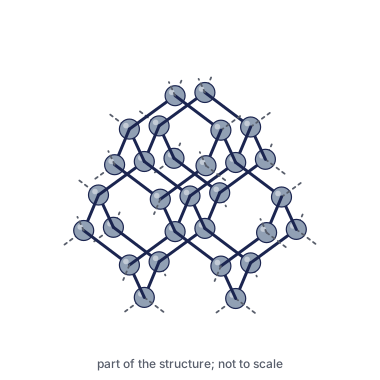
The diagram shows part of the structure of diamond. How many covalent bonds does each carbon atom form?
Circle one answer.
- Two, one to each of two other carbon atoms
- Four, all to carbon atoms in one flat layer
- Four, one to each of four other carbon atoms
- Three, one to each of three other carbon atoms
Nudge (only if you are stuck): Choose an atom in the middle of the diagram, with neighbours all round it, and count its bonds.
2. describe
Match each description to diamond, to graphite, or to both.
Write the number of the matching option.
- Diamond
- Graphite
- Both
- 1. Each carbon atom forms four covalent bonds: ______
- 2. Each carbon atom forms three covalent bonds: ______
- 3. Layers of hexagons held together by weak forces: ______
- 4. A giant covalent structure: ______
- 5. Has delocalised electrons that can move: ______
- 6. A three-dimensional network of strong covalent bonds: ______
Nudge (only if you are stuck): Diamond is one network in all three directions. Graphite is flat layers stacked on each other.
3. explain
A stiff metal zip is rubbed with graphite powder, and afterwards it opens without sticking. Which statement explains why graphite works as a lubricant?
Circle one answer.
- Graphite has delocalised electrons that move along the layers
- The layers are held together by weak forces, so they slide over each other
- Graphite is made of small round molecules that roll like ball bearings
- The covalent bonds between the carbon atoms are weak, so they break easily
Nudge (only if you are stuck): On the bench, graphite left a soft grey smear on the glass slide. What came off the rod?
4. explain
A pupil explains why graphite, not diamond, is used for electrodes: “Graphite conducts because ions move between its layers. Diamond cannot conduct because strong intermolecular forces hold its electrons in place.” (a) Explain why the pupil’s sentence about graphite is incorrect, and give the correct reason that graphite conducts. (b) Explain why the pupil’s sentence about diamond is incorrect, and give the correct reason that diamond does not conduct.
(a) What is wrong about graphite, and the correct reason
(b) What is wrong about diamond, and the correct reason
Nudge (only if you are stuck): Does either solid contain ions, or separate molecules? Carbon has four outer electrons: how many does each solid use in bonds?
5. explain
Match each use to the material and the reason it is chosen.
Write the number of the matching option.
- Diamond: its delocalised electrons conduct electricity
- Diamond: very hard, with strong covalent bonds in all directions
- Graphite: very hard, because each atom has four bonds
- Graphite: its delocalised electrons conduct electricity
- Graphite: its layers slide over each other
- 1. The coating on a wire that slices blocks of marble: ______
- 2. A dry lubricant for a squeaky door hinge: ______
- 3. An electrode in an electrolysis cell: ______
Nudge (only if you are stuck): First ask what each job needs most: hardness, layers that slip, or conducting.
6. describe
Which statements are true of both diamond and graphite? Choose all that apply.
Tick every correct statement.
- Each carbon atom forms four covalent bonds
- They conduct electricity
- They are giant covalent structures
- They are made of small separate molecules
- They are made only of carbon atoms
- They contain strong covalent bonds between carbon atoms
Nudge (only if you are stuck): Test each statement on diamond first, then on graphite.
7. deduce
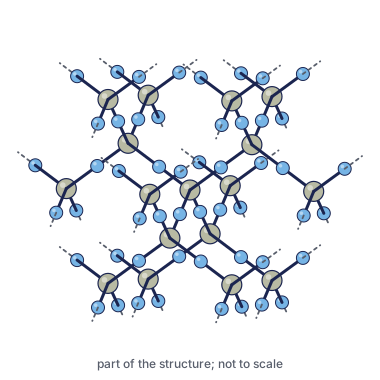
Supplement. The diagram shows part of the structure of silicon(IV) oxide: the large khaki balls are silicon atoms and the small blue balls are oxygen atoms. (a) Deduce the number of oxygen atoms that each silicon atom is bonded to. (b) Deduce the number of silicon atoms that each oxygen atom is bonded to.
(a) Oxygen atoms bonded to each silicon atom: ______________ unit ________
(b) Silicon atoms bonded to each oxygen atom: ______________ unit ________
Nudge (only if you are stuck): Atoms with dashed stubs are at the edge of the piece. Count on the other atoms.
8. explain
Supplement. Diamond and silicon(IV) oxide are both very hard and both have very high melting points. Which statement explains this?
Circle one answer.
- Both are giant ionic lattices, with strong attractions in all directions
- Both have strong intermolecular forces between their large molecules
- Both are giant covalent structures, with strong covalent bonds in all directions
- Both are made only of carbon atoms, joined in the same kind of network
Nudge (only if you are stuck): Think about the particles in each solid, and what holds them together.
9. identify / give / describe
Supplement. The table gives data for four solids, W, X, Y and Z. (a) Identify the solid that has a giant covalent structure like silicon(IV) oxide. Give two pieces of evidence from the table. (b) Describe the structure of silicon(IV) oxide.
| Solid | Melting point / °C | Conducts as a solid? | Conducts when molten? | Hardness |
|---|---|---|---|---|
| W | 114 | no | no | soft, crumbles |
| X | 1085 | yes | yes | bends without breaking |
| Y | 1710 | no | no | very hard: scratches glass |
| Z | 801 | no | yes | hard but shatters |
(a) Which solid, and two pieces of evidence
(b) The structure of silicon(IV) oxide
Nudge (only if you are stuck): Start with the two conductivity columns: what does a solid need to conduct as a solid, or only when molten?
10. identify
Supplement. Diamond and silicon(IV) oxide are both very hard, both have very high melting points, and neither conducts electricity. Which row explains these properties for both solids?
| Row | Particles | What holds the particles together | Why the solid does not conduct |
|---|---|---|---|
| A | small molecules | weak forces between the molecules | the molecules carry no charge |
| B | atoms | strong covalent bonds in a giant three-dimensional network | there are no ions, and no electrons are free to move |
| C | ions | strong ionic bonds in a giant lattice | the ions are held in fixed places |
| D | atoms | strong covalent bonds in a giant three-dimensional network | the delocalised electrons are held in place by the bonds |
Circle one answer.
- A
- B
- C
- D
Nudge (only if you are stuck): Start with the particles in each solid and what holds them together. Then ask whether anything charged can move.
11. deduce / explain / state
Silicon carbide, SiC, is used for armour plates and for the brake discs of some racing cars. It stays solid up to about 2700 °C and conducts electricity only very poorly. In silicon carbide, each silicon atom is covalently bonded to four carbon atoms, and each carbon atom to four silicon atoms, in a three-dimensional network. (a) Deduce whether its structure is more like diamond or like graphite. Explain your choice using its bonding and its poor conductivity. (b) Explain why silicon carbide makes armour plates that are very hard to scratch or dent. (c) Supplement: explain why its formula is SiC, even though each silicon atom is bonded to four carbon atoms. (d) Supplement: silicon(IV) oxide is also very hard and does not conduct. State what the structures of silicon carbide, silicon(IV) oxide and diamond have in common.
(a) Diamond or graphite, and why
(b) Why it suits armour plates
(c) Supplement: why the formula is SiC
(d) Supplement: what the three structures have in common
Nudge (only if you are stuck): Count the bonds per atom and the directions they go in, then compare with diamond and graphite. For (c), count from a carbon atom too.