Pupil sheet · Formulae and equations
Reading a formula — questions
Name ______________________ Date ____________
Try every question before you use a nudge. Write in full sentences where you are asked to explain.
1. define
Which statement defines the molecular formula of a compound?
Circle one answer.
- The mass of one molecule of the compound
- The number and type of different atoms in one molecule
- The way the atoms are arranged in space in one molecule
- The simplest whole number ratio of the different atoms in a compound
Nudge (only if you are stuck): Think of what you count in a model of one molecule.
2. deduce
The model shows one molecule of ethane. Count the atoms of each element, then write the molecular formula of ethane in the box.
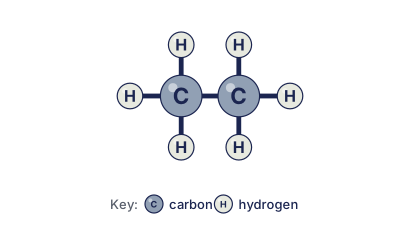
Carbon atoms in one molecule: ______________ unit ________
Hydrogen atoms in one molecule: ______________ unit ________
Write the molecular formula of ethane.
Nudge (only if you are stuck): Count the grey balls, then the small white ones.
3. state
Match each compound to its formula.
Write the number of the matching option.
- CH4
- H2O
- NaCl
- CO2
- CaCO3
- NH3
- 1. Water: ______
- 2. Carbon dioxide: ______
- 3. Methane: ______
- 4. Ammonia: ______
- 5. Sodium chloride: ______
- 6. Calcium carbonate: ______
Nudge (only if you are stuck): Count what each name tells you: "di" means two; "oxide" means oxygen.
4. state
Calcium nitrate has the formula Ca(NO3)2. How many atoms of each element does this formula show?
Calcium atoms: ______________ unit ________
Nitrogen atoms: ______________ unit ________
Oxygen atoms: ______________ unit ________
Nudge (only if you are stuck): What does the 2 after the bracket multiply?
5. deduce
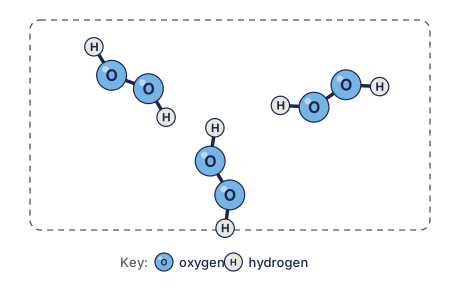
The box shows a sample of hydrogen peroxide. What is the molecular formula of hydrogen peroxide?
Circle one answer.
- H2O
- HO
- H2O2
- H6O6
Nudge (only if you are stuck): How many molecules are in the box? Count the atoms in one of them.
6. state
Which of these are the correct formulae of the elements as they are found at room temperature? Choose all that are correct.
Tick every correct statement.
- Na2
- O2
- N2
- Cl
- Mg
- He
Nudge (only if you are stuck): Which elements are molecules of two atoms, which are single atoms, and which are giant structures?
7. deduce
Supplement. Ethane has the molecular formula C2H6. What is its empirical formula?
Circle one answer.
- CH3
- CH2
- C2H6
- CH6
Nudge (only if you are stuck): Find the largest number that divides both 2 and 6.
8. deduce
Supplement. Match each molecular formula to its empirical formula.
Write the number of the matching option.
- C3H8
- HO
- NO2
- C2H5
- CH2
- 1. H2O2: ______
- 2. C4H10: ______
- 3. C3H8: ______
- 4. N2O4: ______
Nudge (only if you are stuck): For each one, find the largest number that divides every subscript. It might be 1.
9. deduce
Supplement. Match each pair of ions to the formula of the compound they form.
Write the number of the matching option.
- MgCl2
- Ca(OH)2
- NaCl
- Al2O3
- MgCl
- 1. Na+ and Cl−: ______
- 2. Mg2+ and Cl−: ______
- 3. Al3+ and O2−: ______
- 4. Ca2+ and OH−: ______
Nudge (only if you are stuck): Take enough of each ion for the charges to add up to zero.
10. deduce
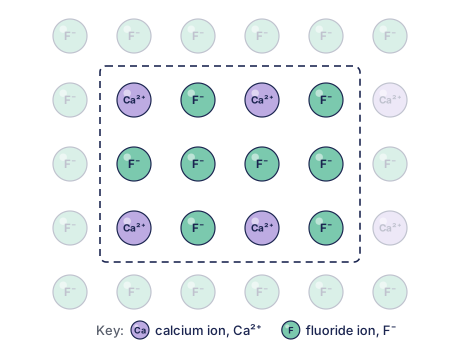
Supplement. The diagram shows part of the lattice of calcium fluoride. Deduce its formula.
Circle one answer.
- Ca4F8
- CaF2
- CaF
- Ca2F
Nudge (only if you are stuck): Count each kind of ion inside the box, then write the simplest ratio. Check the charges.
11. state / deduce
At a water treatment works, aluminium sulfate, Al2(SO4)3, is added to make tiny particles clump together, and chlorine gas is added to kill microbes. (a) Write the formula of chlorine, and say what this molecular formula tells you about one molecule. (b) How many atoms of each element does the formula Al2(SO4)3 show? (c) In the water, chlorine makes a substance that kills the microbes. A model of one of its molecules has one hydrogen atom joined to one oxygen atom, which is joined to one chlorine atom. Write its formula. (d) Supplement: aluminium sulfate contains Al3+ and SO42− ions. Show how the charges give the formula Al2(SO4)3. (e) Supplement: water for power-station boilers is treated with hydrazine, N2H4, to remove dissolved oxygen. Write the empirical formula of hydrazine.
(a) Formula of chlorine and its meaning
(b) Atoms of each element in Al2(SO4)3
(c) Formula from the model
(d) Supplement: the charges
(e) Supplement: empirical formula of hydrazine
Nudge (only if you are stuck): In (b), what does the 3 after the bracket multiply? In (d), find a total that both charges can make.