Pupil sheet · Acids, bases and indicators
Acids, bases and indicators — final check
Name ______________________ Date ____________
Work alone, with the lesson closed. Answer every question; there are no hints.
1. identify
Drops of four solutions, J, K, L and M, are put on universal indicator paper. J turns it green, K purple, L red and M yellow. Which row is correct?
| Row | Most acidic, highest concentration of H+ ions | Neutral | Most alkaline |
|---|---|---|---|
| A | M | J | K |
| B | L | J | K |
| C | L | M | K |
| D | K | J | L |
Circle one answer.
- A
- B
- C
- D
2. state / explain
A rust remover E contains phosphoric acid; its pH is 2. A floor cleaner F contains aqueous ammonia; its pH is 11. (a) State the colours of litmus, methyl orange and thymolphthalein in E. (b) State the colours of litmus and of thymolphthalein in F. (c) Name the ion that makes F alkaline. (d) A pupil tests F with methyl orange only, sees yellow and says this proves F is an alkali. Explain why the test does not prove it.
(a) Litmus, methyl orange and thymolphthalein in E
(b) Litmus and thymolphthalein in F
(c) The ion in F
(d) Why methyl orange alone does not prove it
3. name / deduce / give
A white solid X is tested. With dilute hydrochloric acid it fizzes, and the gas turns limewater milky. Warmed with sodium hydroxide solution, it gives a gas that turns damp red litmus paper blue. (a) Name the gas given off with the acid. (b) Name the gas given off with sodium hydroxide. (c) X is one of ammonium carbonate, sodium carbonate and ammonium chloride. Deduce which. (d) Give the word equation for X with hydrochloric acid. (e) A second solid, Y, is a metal. It also fizzes with dilute hydrochloric acid. Name the gas, and give its test and result.
(a) Gas with the acid
(b) Gas with sodium hydroxide
(c) X
(d) Word equation
(e) The gas from Y, and its test
4. explain / give / predict
Sodium hydroxide solution is neutralised by dilute nitric acid. (a) Explain why sodium hydroxide is both a base and an alkali. (b) Give the word equation. (c) Give the ionic equation, with state symbols. (d) A pupil keeps adding acid after the solution is neutral. Predict the pH, and explain.
(a) Base and alkali
(b) Word equation
(c) Ionic equation
(d) The pH with extra acid
5. identify
Supplement. The diagram shows two acid solutions, R and S, at the same concentration. Which row is correct?
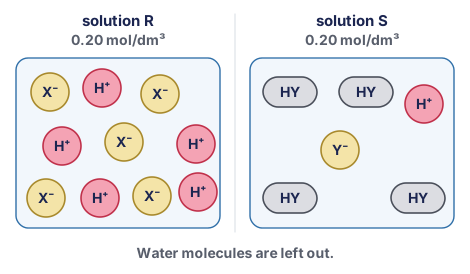
| Row | Strong acid | Higher concentration of H+ ions | Lower pH |
|---|---|---|---|
| A | R | R | R |
| B | S | S | S |
| C | R | R | S |
| D | both: same concentration | the same | the same |
Circle one answer.
- A
- B
- C
- D
6. deduce / give / identify
Supplement. A kettle descaler contains one acid at 0.50 mol/dm³, either hydrochloric acid or ethanoic acid. Its pH is 2.5. Hydrochloric acid at 0.50 mol/dm³ has a pH of 0.3. (a) Deduce which acid the descaler contains, and explain. (b) Give the equations for the dissociation in water of hydrochloric acid and of ethanoic acid, with state symbols. (c) The acid removes limescale, calcium carbonate: the carbonate ions, CO32−, take H+ ions from the acid. Identify the proton donor and the proton acceptor in this reaction.
(a) The acid, and why
(b) The two equations
(c) Donor and acceptor