Pupil sheet · Plant responses
Shoots that turn to the light — questions
Name ______________________ Date ____________
Try every question before you use a nudge. Write in full sentences where you are asked to explain.
1. describe
Which statement describes phototropism?
Circle one answer.
- A response in which a plant grows taller in bright light than it does in dim light.
- A response in which parts of a plant grow towards or away from the direction of the light source.
- A process in which a plant uses light energy to make glucose from carbon dioxide and water.
- A response in which parts of a plant grow towards or away from gravity.
Nudge (only if you are stuck): Think of the shoots on the windowsill: what made them curve, and how did the curve form?
2. identify
Which of these is an example of phototropism?
Circle one answer.
- Bean shoots in a dark cupboard grow round towards a gap in the door where light gets in.
- The root of a seedling in a closed dark box grows straight downwards.
- Tomato plants in a sunny greenhouse grow faster than tomatoes in the shade.
- The leaves of a mimosa plant fold up within seconds when they are touched.
Nudge (only if you are stuck): Look for a growth response to the direction the light comes from.
3. identify
A student puts small black paper caps on the tips of some cress shoots and leaves other shoots uncovered. A lamp shines on them from one side. Only the uncovered shoots bend. Which extra group would show that the paper itself does not stop the bending?
Circle one answer.
- Shoots with their tips cut off.
- Shoots with caps of clear plastic on their tips.
- Twice as many shoots with black paper caps.
- Shoots with black paper caps, kept in a dark cupboard.
Nudge (only if you are stuck): The extra group needs caps too, but caps that change one thing.
4. state
The figure shows a protractor placed on a cress shoot after a day of light from the right. State the bend angle of the shoot.
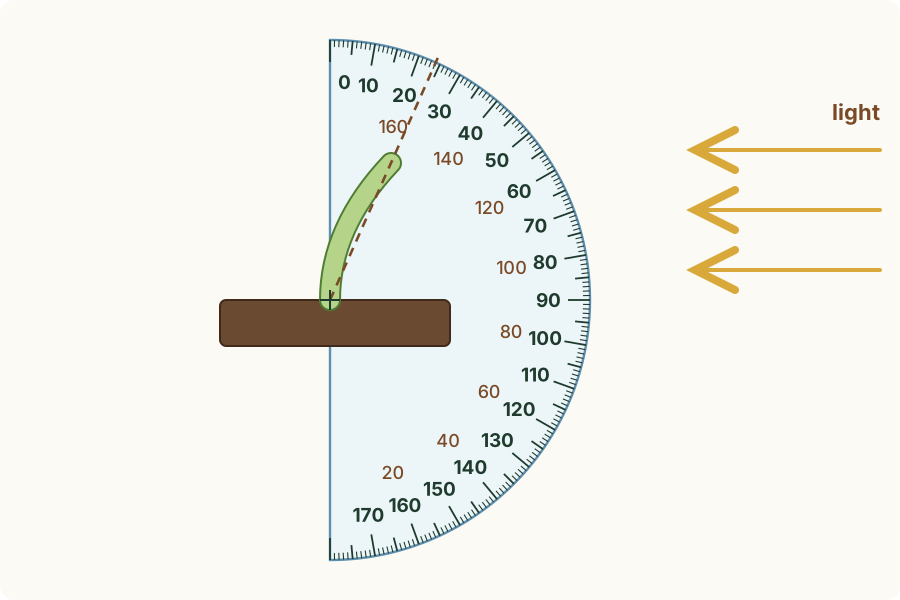
Bend angle: ______________ unit ________
Nudge (only if you are stuck): Follow the dashed line from the base to the tip until it meets the scale that reads 0° on the upright line.
5. identify
Four groups of oat seedlings were lit from one side for a day. The table shows what was done and the results. Which part of the shoot detects the direction of the light?
| Group | What was done | Result after a day |
|---|---|---|
| 1 | left as they are | bent towards the light |
| 2 | tips cut off | did not bend |
| 3 | foil caps on the tips | did not bend |
| 4 | foil round the lower half of each shoot | bent towards the light |
Circle one answer.
- The roots in the compost.
- The tip of the shoot.
- The whole shoot, equally.
- The lower half of the shoot.
Nudge (only if you are stuck): Find what groups 2 and 3 have in common that groups 1 and 4 do not.
6. determine
The graph shows the bend angle of cress shoots lit from one side and of cress shoots lit from above. Determine (a) the bend angle of the shoots lit from one side at 6 hours, (b) the increase in their bend angle between 8 hours and 12 hours.
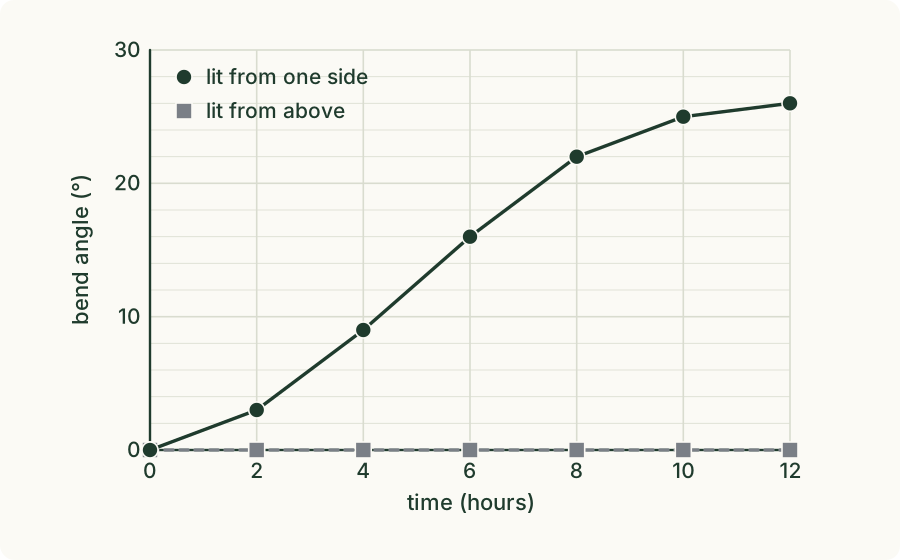
(a) Bend angle at 6 hours: ______________ unit ________
(b) Increase from 8 to 12 hours: ______________ unit ________
Nudge (only if you are stuck): Use the line for the shoots lit from one side. Each gridline is 2°.
7. describe / compare
Use the same graph. Describe how the bend angle of the shoots lit from one side changed over the 12 hours, and compare it with the shoots lit from above.
Nudge (only if you are stuck): Look for where the line rises steeply, where it flattens, and where the other line stays.
8. identify
Three groups of oat seedlings are lit from one side for a day: group 1 with foil caps on the tips, group 2 with foil round the base of each shoot, group 3 with clear plastic caps on the tips. Which row shows the results?
| Row | Group 1: foil caps | Group 2: foil round the base | Group 3: clear caps |
|---|---|---|---|
| A | bends | stays straight | bends |
| B | stays straight | stays straight | bends |
| C | stays straight | bends | bends |
| D | bends | bends | stays straight |
Circle one answer.
- A
- B
- C
- D
Nudge (only if you are stuck): For each group, check whether light can reach the tip.
9. explain / suggest
A student tests whether the tip detects light. The pot of shoots with foil caps stands 1 m from the lamp and the pot of uncovered shoots 0.5 m from it. Explain why this is not a fair test, and suggest how to improve it.
Nudge (only if you are stuck): List what is different between the two pots. How many differences should there be?
10. identify / calculate
Five oat shoots in one pot were lit from one side for a day. Their bend angles are in the table. (a) Identify the anomalous result. (b) Calculate the mean bend angle, leaving out the anomalous result.
| Shoot | 1 | 2 | 3 | 4 | 5 |
|---|---|---|---|---|---|
| Bend angle (°) | 26 | 30 | 8 | 29 | 27 |
(a) Anomalous result: ______________ unit ________
(b) Mean without the anomaly: ______________ unit ________
Nudge (only if you are stuck): One value does not fit the pattern of the others. Leave it out, then add the rest and divide by how many you added.
11. calculate
An oat shoot grew from 21 mm to 34 mm long in 24 hours. Calculate its mean rate of growth in mm per hour. Give your answer to 2 significant figures.
Mean rate of growth: ______________ unit ________
Nudge (only if you are stuck): Find the increase in length first, then divide by the time.
12. explain / describe
A student writes: "The shoot bends towards the window because it wants more light." Explain why this is incorrect, and describe what really happens.
Nudge (only if you are stuck): Can a plant want anything? What happens to the two sides of the shoot?
13. predict / explain
A pot of cress seedlings stands on a slowly turning turntable beside a window, so that each side of the pot faces the window in turn. Predict the shape of the shoots after three days, and explain your prediction.
Nudge (only if you are stuck): Does any one side of a shoot stay in the shade for longer than the others?
14. explain / suggest
A student cuts the tips off some oat shoots and lights them from one side. They do not bend. The student concludes: "The tip detects the light." Explain why this conclusion is not safe from this experiment alone, and suggest a better test.
Nudge (only if you are stuck): Cutting off the tip changes more than one thing about the shoot.