Pupil sheet · Plant responses
Plant responses — final check
Name ______________________ Date ____________
Work alone, with the lesson closed. Answer every question; there are no hints.
1. predict
The figure shows five oat seedlings P to T at the start of an experiment. They are lit from the right for a day. Predict which seedlings will bend towards the light.
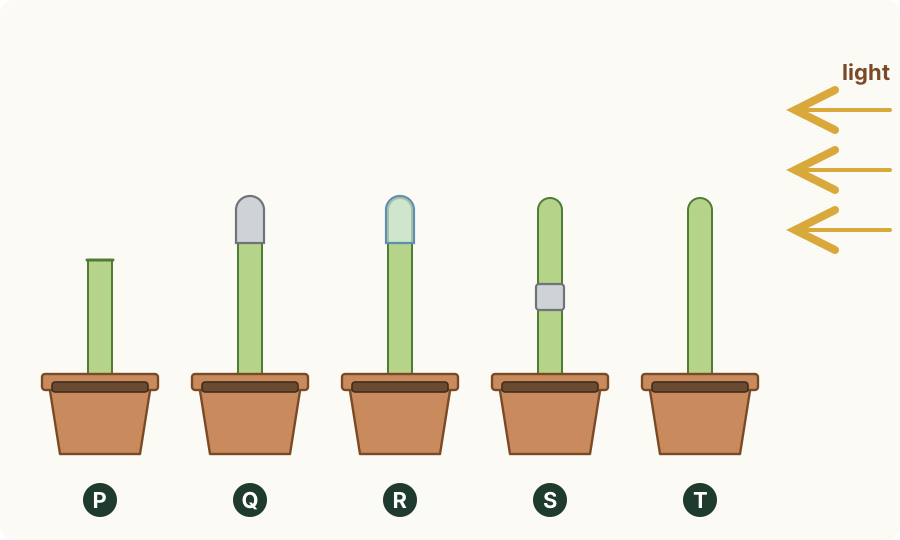
Tick every correct statement.
- P: the tip cut off
- Q: a foil cap on the tip
- S: a band of foil round the middle
- R: a clear plastic cap on the tip
- T: left as it is
2. identify / suggest
A gardener sees that radish seedlings on a windowsill all lean towards the glass. (a) Identify the stimulus and the response. (b) Suggest a control that would show that the lean is caused by the light coming from one side.
(a) Stimulus and response
(b) Control
3. predict
Three bean seedlings are laid on their sides for a day: P on a still disc in the dark, Q on a turning clinostat in the dark, R on a still disc with a lamp shining from above. Predict the direction in which each shoot grows by the end of the day.
P
Q
R
4. identify
Which of these is an example of gravitropism?
Circle one answer.
- A young sunflower turning its head to face the morning sun.
- A ripe apple falling from a tree to the ground below.
- The tendrils of a pea plant coiling round a stick that they touch.
- A tree blown over in a storm: over the next year its branch tips turn to grow upwards.
5. explain
Supplement: maize seedlings grow on a shelf below a window on their right. Explain, in terms of auxin, why their shoots curve to the right.
6. explain
Supplement: (a) A shoot lying on its side is fixed to a turning clinostat in the dark. Explain, in terms of auxin, why it grows straight out sideways. (b) Explain why the upward curve of a shoot left lying on its side on a still disc is an example of the chemical control of plant growth.
(a) On the clinostat
(b) Chemical control