Pupil sheet · Chemical digestion
Acid and alkali — questions
Name ______________________ Date ____________
Try every question before you use a nudge. Write in full sentences where you are asked to explain.
1. identify
Gastric juice contains hydrochloric acid. Which two of these are functions of the hydrochloric acid in gastric juice?
Tick every correct statement.
- It breaks the fat in food into small droplets
- It digests the starch in food into sugars
- It gives the best pH for the stomach's protease
- It digests the protein in food into amino acids
- It neutralises the food so enzymes can work
- It kills harmful microorganisms in food
Nudge (only if you are stuck): Think of what can be carried in food, and of tube 3 of the experiment, which had acid but no enzyme.
2. identify
A pupil puts a cube of boiled egg white into each of four tubes and leaves them at 37 °C for one day. The table shows what each tube held and what happened to the cube. Which tube shows that the acid on its own does not digest protein?
| Tube | Contents | pH | Egg-white cube after one day |
|---|---|---|---|
| W | pepsin and hydrochloric acid | 2 | much smaller |
| X | pepsin and water | 7 | no change |
| Y | hydrochloric acid and water | 2 | no change |
| Z | none (water) | 7 | no change |
Circle one answer.
- Tube W
- Tube Y
- Tube Z
- Tube X
Nudge (only if you are stuck): Look for a tube with acid in it but nothing else that could digest protein.
3. identify
Supplement. Food a little way along the duodenum has been partly neutralised by bile and pancreatic juice, and is at about pH 6. Use the graph. Which protease can digest protein at pH 6?
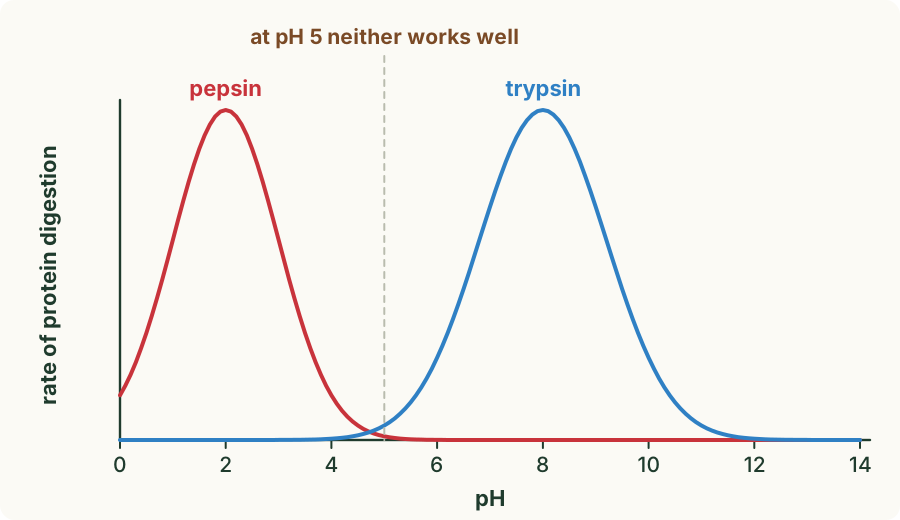
Circle one answer.
- Both equally: pH 6 lies halfway between their peaks
- Trypsin: its curve is above zero and rising at pH 6
- Neither: both of the curves are at zero at pH 6
- Pepsin: its curve is still high because pH 6 is acidic
Nudge (only if you are stuck): Find pH 6 on the horizontal axis and read upwards: is each curve above zero there?
4. sequence
Supplement. Put the steps in order, from where bile is made to how it helps the enzymes of the small intestine.
Write the number of each step in order.
- The enzymes of the small intestine work at a suitable pH
- Bile flows along the bile duct
- Bile enters the duodenum
- The alkaline bile neutralises the acid from the stomach
- Bile is stored in the gall bladder
- Bile is made in the liver
- Step 1: ______
- Step 2: ______
- Step 3: ______
- Step 4: ______
- Step 5: ______
- Step 6: ______
Nudge (only if you are stuck): Bile is made in one organ, stored in another, and then travels along a tube to the start of the small intestine.
5. explain
The protease of the stomach works fastest at about pH 2. A pupil says: "If the stomach made more acid, so that its contents were at pH 1 instead of pH 2, it would digest protein even faster." Explain why the pupil is wrong.
Nudge (only if you are stuck): What does the word optimum mean for an enzyme?
6. calculate / determine
Supplement. A pupil times how long pepsin takes to clear an egg-white suspension at five pH values, three times at each pH. (a) One time at pH 3 is anomalous. Calculate the mean time at pH 3, leaving out the anomalous result. Give your answer to 1 decimal place. (b) Determine the pH at which pepsin digested protein fastest. Then explain how this result suits the place where pepsin works.
| pH | Time 1 / min | Time 2 / min | Time 3 / min |
|---|---|---|---|
| 1 | 6.5 | 7.0 | 6.0 |
| 2 | 4.0 | 4.5 | 4.0 |
| 3 | 6.0 | 9.5 | 6.4 |
| 4 | 15.0 | 14.5 | 15.5 |
| 5 | not clear after 30 | not clear after 30 | not clear after 30 |
(a) Mean time at pH 3: ______________ unit ________
(b) pH of fastest digestion: ______________ unit ________
How this result suits the place where pepsin works
Nudge (only if you are stuck): An anomalous result does not fit the pattern of the other repeats. A shorter time to clear means faster digestion.
7. predict
Supplement. Tubes X and Y each hold the same egg-white suspension, the same volume of trypsin and dilute hydrochloric acid, at pH 2 and 37 °C. A pupil stirs a large volume of bile into tube X and the same volume of water into tube Y. Predict which row is correct for tube X compared with tube Y.
| Row | pH in tube X | Egg white in tube X |
|---|---|---|
| A | lower | clears sooner |
| B | higher | clears no sooner |
| C | higher | clears sooner |
| D | lower | clears no sooner |
Circle one answer.
- A
- B
- C
- D
Nudge (only if you are stuck): Is bile acidic or alkaline? Then: is trypsin nearer to its optimum pH in tube X or in tube Y?
8. state / predict / explain
Supplement. A doctor measures the pH at two points in a patient's duodenum after a meal. Point P is before the openings of the bile duct and the pancreatic duct: pH 4. Point Q is after them: pH 7. (a) State the two alkaline fluids that raise the pH between P and Q. (b) Use the graph to predict at which point trypsin digests protein faster, and explain your prediction.
(a) The two alkaline fluids
(b) The point where trypsin is faster, and why
Nudge (only if you are stuck): Which fluids enter the duodenum along those two ducts? Then read the trypsin curve at pH 4 and at pH 7.
9. explain
A pupil plans to show that pepsin needs the acid of the stomach. Tube 1: egg white, pepsin and hydrochloric acid at pH 2, in a water bath at 37 °C. Tube 2: egg white and pepsin in water at pH 7, left on the bench at 20 °C. (a) Explain why this is not a fair test. (b) Explain why she also needs a tube with egg white and acid at pH 2, but no pepsin.
(a) Why it is not a fair test
(b) Why a tube with acid but no pepsin is needed
Nudge (only if you are stuck): How many things are different between tubes 1 and 2? If tube 1 is digested, what else besides pepsin might have done it?
10. calculate / explain
Food-poisoning bacteria from raw prawns are added to two flasks at 37 °C. Flask 1 holds dilute hydrochloric acid at pH 2, like gastric juice; flask 2 holds water at pH 6. Each flask starts with 2400 live bacteria. After 40 minutes, 36 bacteria are still alive in flask 1 and 2280 in flask 2. (a) Calculate the percentage of the bacteria killed in flask 1. (b) Calculate the percentage killed in flask 2. Give each answer to 1 decimal place. (c) Explain what the results show about a function of the hydrochloric acid in gastric juice.
(a) Percentage killed in flask 1: ______________ unit ________
(b) Percentage killed in flask 2: ______________ unit ________
(c) What the results show about a function of the acid
Nudge (only if you are stuck): What fraction of the 2400 bacteria did not survive?
11. explain / state
Supplement. When food leaves the stomach, some pepsin goes with it into the duodenum. A pupil writes: "This pepsin goes on digesting protein all along the small intestine." Use the graph and the conditions in the small intestine to explain why this statement is incorrect, and state which protease digests protein there.
Nudge (only if you are stuck): What are the conditions in the small intestine? Find them on the pH axis.
12. suggest / explain
Supplement. Imagine that the bile duct opened into the stomach instead of into the duodenum. (a) Suggest the effect on protein digestion in the stomach. (b) Suggest the effect on the harmful microorganisms in food. (c) Explain why the duodenum is the right place for bile to enter.
(a) Effect on protein digestion in the stomach
(b) Effect on harmful microorganisms
(c) Why the duodenum is the right place
Nudge (only if you are stuck): Bile is alkaline. What would it do to the acid in the stomach, and which two jobs need that acid?
13. describe
Supplement. Your results show that trypsin clears egg-white suspension at pH 8 but not at pH 2. Describe how you would find the optimum pH of trypsin more precisely: what you would change, what you would keep the same, what you would measure and the control you would use.
(a) What you change, and the values you choose
(b) What you keep the same
(c) What you measure
(d) Your control, and how you decide the optimum
Nudge (only if you are stuck): Two pH values cannot show where the peak is. Which pH values would you test, and how would you tell which one is fastest?