Pupil sheet · Chemical digestion
Three enzymes, three foods — questions
Name ______________________ Date ____________
Try every question before you use a nudge. Write in full sentences where you are asked to explain.
1. describe
Match each enzyme to the products it makes when it breaks its food down.
Write the number of the matching option.
- Tiny droplets of fat
- Fatty acids and glycerol
- Amino acids
- Starch
- Simple reducing sugars
- Amylase: ______
- Protease: ______
- Lipase: ______
Nudge (only if you are stuck): Use the table "One enzyme for each food". Which food does each enzyme act on, and what is that food built from?
2. calculate
Each fat molecule is built from one glycerol joined to three fatty acids. (a) In one tube, lipase completely digests 40 fat molecules. Calculate how many fatty acid molecules and how many glycerol molecules are made. (b) In another tube, lipase makes 270 fatty acid molecules. Calculate how many fat molecules it digested.
(a) Fatty acid molecules: ______________ unit ________
(a) Glycerol molecules: ______________ unit ________
(b) Fat molecules digested: ______________ unit ________
Nudge (only if you are stuck): Think of one fat molecule first: how many of each product does it give? Then scale up.
3. identify
The drawing shows the digestive system, with eight organs lettered A to H. Which letter shows the organ that secretes lipase?
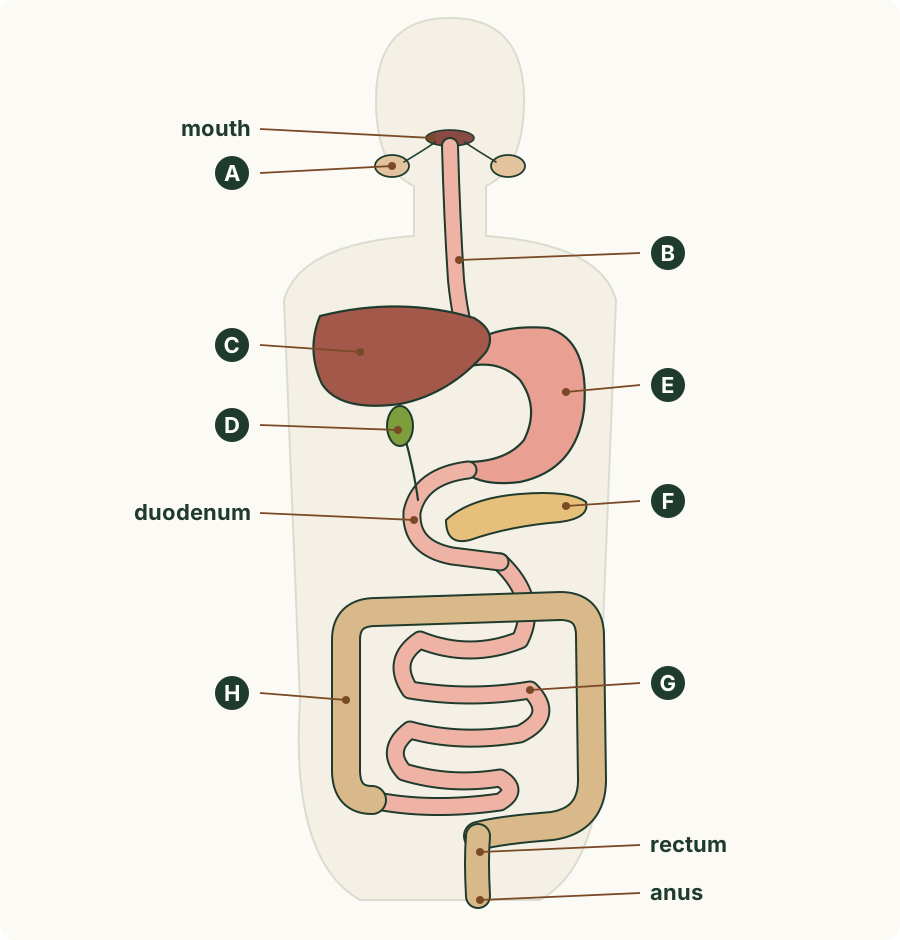
Circle one answer.
- Organ C
- Organ F
- Organ D
- Organ E
Nudge (only if you are stuck): Lipase is secreted by only one gland, and that gland makes the other two enzymes as well.
4. identify
Match each organ to the digestive enzymes it secretes.
Write the number of the matching option.
- Lipase only
- None of these three
- Protease only
- Amylase only
- Amylase, protease and lipase
- Salivary glands: ______
- Stomach: ______
- Pancreas: ______
- Liver: ______
Nudge (only if you are stuck): Use the table "Where each enzyme is made and where it works". One gland appears in all three rows.
5. classify
Each food is mostly one kind of large molecule. Match each food to the enzyme that digests its main molecule.
Write the number of the matching option.
- Bile
- Amylase
- Protease
- Lipase
- Rice: ______
- Chicken breast: ______
- Sunflower oil: ______
- Coconut oil: ______
- Noodles: ______
- White fish: ______
Nudge (only if you are stuck): First decide whether each food is mostly starch, protein or fat. Then choose the enzyme for that molecule.
6. identify
Which row is correct for one digestive enzyme?
| Row | Enzyme | Secreted by | Acts in |
|---|---|---|---|
| A | lipase | liver | small intestine |
| B | protease | pancreas | pancreas |
| C | amylase | salivary glands | mouth |
| D | lipase | pancreas | stomach |
Circle one answer.
- A
- B
- C
- D
Nudge (only if you are stuck): Check each row one column at a time: the enzyme, then the organ that secretes it, then the place where it acts.
7. identify
Look at the drawing of the digestive system. Which lettered organs secrete an enzyme that digests protein? Choose all that are right.
Tick every correct statement.
- Organ D
- Organ C
- Organ H
- Organ F
- Organ E
- Organ A
Nudge (only if you are stuck): Which enzyme digests protein? Then: which organs make it?
8. explain
A pupil writes: "The pancreas digests fat, because lipase is made there." Explain why this statement is incorrect.
Nudge (only if you are stuck): Is the place where lipase is made the same as the place where it works? Follow the pancreatic juice.
9. explain
Two tubes hold the same full-cream milk, which contains fat and protein but no starch, with universal indicator and a little alkali: both are blue, about pH 9. A pupil adds lipase to tube 1 and amylase to tube 2, and keeps both at 37 °C. After 30 minutes, tube 1 has turned yellow-green, about pH 6; tube 2 is still blue. Explain the results. (Fatty acids, as their name says, are acids.)
Nudge (only if you are stuck): Which molecule does each enzyme act on, and is that molecule in the milk?
10. explain
Some medicines make the salivary glands produce very little saliva. A person taking one of these medicines eats a bowl of porridge, made from oats, which is mostly starch. Explain whether the starch in the porridge will still be digested, and where.
Nudge (only if you are stuck): Look at where amylase is secreted. Does all of it come from the salivary glands?
11. explain
Biological washing powder contains protease and lipase. It removes stains of egg and of grease from clothes better than washing powder without enzymes. Explain how the two enzymes help to remove these stains.
Nudge (only if you are stuck): Which kind of large molecule is egg rich in, and which kind is grease? What are the products, and what happens to them in the water?
12. explain / suggest
A pupil chews a mouthful of plain boiled rice with a little margarine for two minutes without swallowing. The rice starts to taste sweet, but the margarine, a fat, does not change. (a) Explain why the rice starts to taste sweet. (b) Suggest why the fat in the margarine is not digested in the mouth.
(a) Why the rice starts to taste sweet
(b) Why the fat is not digested in the mouth
Nudge (only if you are stuck): Which enzyme is in saliva, and which kind of molecule does it act on?