Pupil sheet · Blood vessels
Capillaries — questions
Name ______________________ Date ____________
Try every question before you use a nudge. Write in full sentences where you are asked to explain.
1. describe
Which statement describes a capillary?
Circle one answer.
- a thin muscular wall and a wide lumen with valves
- a wall one cell thick and a lumen about one red blood cell wide
- a thick elastic wall and a narrow lumen
- a wall one cell thick and a lumen wider than an artery's
Nudge (only if you are stuck): Think of the ×400 field: how thick was the wall, and how wide the lumen?
2. state
The diagram shows blood flowing through capillaries between the cells of a tissue. Which substances pass from the blood to the cells, and which from the cells to the blood?
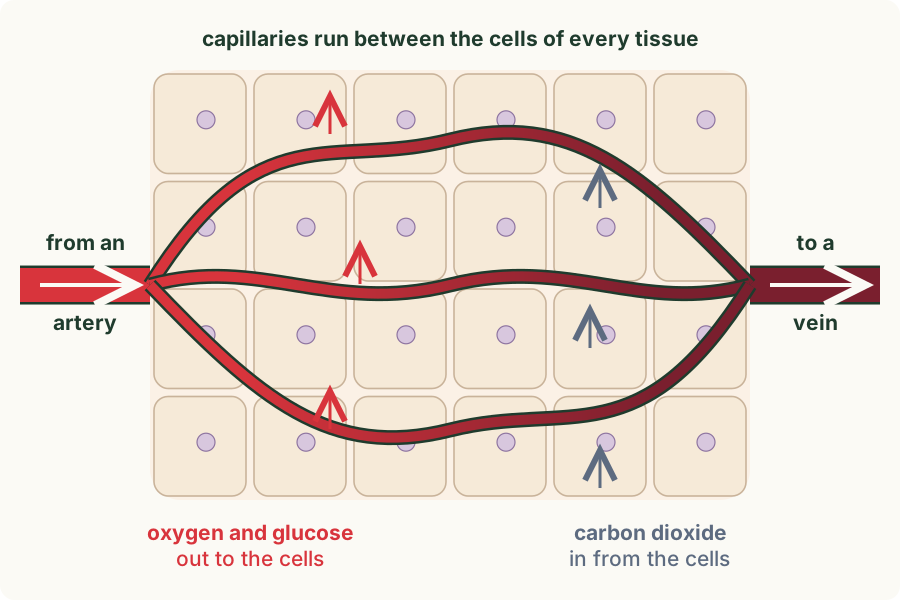
Write the number of the matching option.
- from the cells to the blood
- from the blood to the cells
- oxygen: ______
- glucose: ______
- carbon dioxide: ______
Nudge (only if you are stuck): Which substances do the cells use in respiration, and which do they make?
3. explain
Supplement. Why is a capillary's wall only one cell thick?
Circle one answer.
- it lets red blood cells squeeze out to the tissue
- it withstands the high pressure of the blood
- it stops the blood flowing backwards
- it gives a short diffusion distance, so exchange is fast
Nudge (only if you are stuck): How far would oxygen have to diffuse through a thick wall?
4. describe
Describe how a capillary differs in structure from an artery. Give two differences.
(a) First difference
(b) Second difference
Nudge (only if you are stuck): Compare the walls and the lumens.
5. state
State two functions of capillaries.
(a) First function
(b) Second function
Nudge (only if you are stuck): Where do capillaries run, and what happens across their walls?
6. calculate
Supplement. Vein Y on your slide had a wall about 65 µm thick, much thinner than an artery's. A capillary's wall is about 0.5 µm thick. How many times further would oxygen have to diffuse to cross the vein's wall than to cross a capillary's wall?
Times further: ______________ unit ________
Nudge (only if you are stuck): Divide the thicker wall by the thinner one.
7. explain
Supplement. In the lungs, capillaries are wrapped round the air sacs. Explain how the narrow lumen of these capillaries helps oxygen get from the air in an air sac into the red blood cells.
Nudge (only if you are stuck): Where is each red blood cell, compared with the capillary wall and the air sac?
8. identify
A student looking at a slide at ×100 sees a tiny vessel with one red blood cell inside it and calls it "a small artery". A capillary is about 8 µm across. Use the size of the ×100 field of view (1800 µm across) to explain why the student cannot see the wall of this vessel at ×100, and what they should do to decide what it is.
Nudge (only if you are stuck): What fraction of the field is 8 µm?
9. suggest
A shallow cut in the skin does not bleed, but a deeper cut does. Suggest which layer of the skin has no capillaries, and explain how its cells still get oxygen and glucose.
Nudge (only if you are stuck): Cells without capillaries close by must get substances another way.
10. explain
Supplement. A tumour is a lump of cells that keep dividing. A tumour cannot grow much bigger than about 2 mm across unless new capillaries grow into it. Use what you know about capillaries to explain why.
Nudge (only if you are stuck): How far can oxygen diffuse quickly? How far are the cells in the middle of the lump from the blood?