Pupil sheet · Blood vessels
Artery or vein? — questions
Name ______________________ Date ____________
Try every question before you use a nudge. Write in full sentences where you are asked to explain.
1. describe
Which statement describes an artery compared with a vein?
Circle one answer.
- a thicker wall and a narrower lumen
- a thinner wall and a wider lumen
- a wall one cell thick and no lumen
- a thicker wall and a wider lumen
Nudge (only if you are stuck): Think of the artery on your slide: how thick was its wall compared with its lumen?
2. identify
The diagram shows three blood vessels cut across. Match each letter to the vessel it shows.
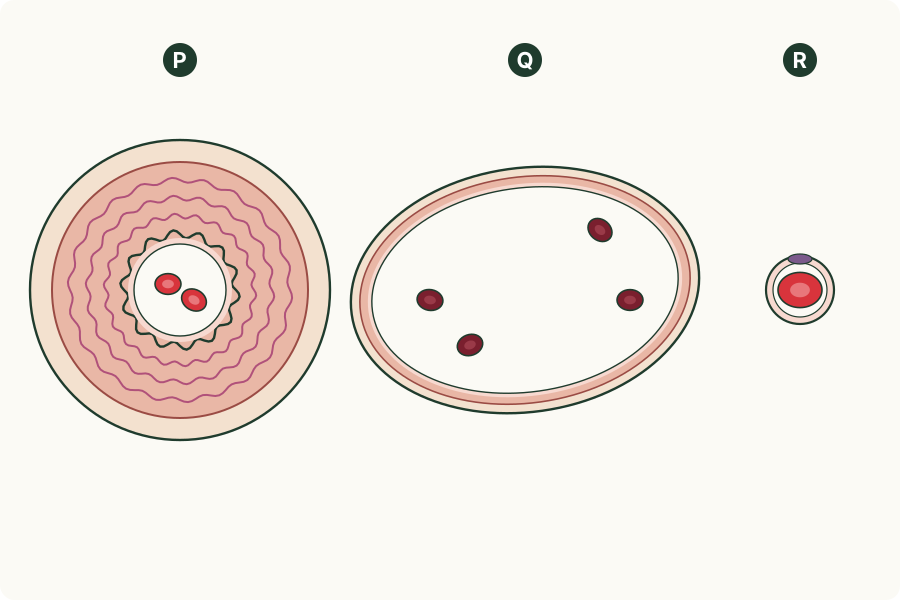
Write the number of the matching option.
- vein
- capillary
- artery
- P: ______
- Q: ______
- R: ______
Nudge (only if you are stuck): Look at the wall of each: thick with muscle, thin, or one cell thick?
3. complete
Complete the sentences about valves.
Valves are found along the length of … .
They prevent the … of blood.
So the blood can only flow … the heart.
Nudge (only if you are stuck): Valves are found in one kind of vessel only. What do they stop?
4. explain
Supplement. Which statement explains why an artery has a thick wall?
Circle one answer.
- to withstand the high pressure of the blood
- to stop the blood flowing back to the heart
- to stop oxygen leaking out of the blood
- to make the blood flow more slowly
Nudge (only if you are stuck): Where has the blood in an artery just come from?
5. explain
Supplement. The elastic tissue in an artery's wall stretches as each surge of blood arrives. What does it do between beats, and what is the result?
Nudge (only if you are stuck): An elastic band that is stretched and let go: what does it do?
6. calculate
On a slide at ×100 showing a transverse section of a vessel, a line through its centre crosses its wall on the left over 280 µm and on the right over 320 µm. The lumen between the inner edges is 300 µm. (a) Calculate the wall thickness. (b) Calculate wall ÷ lumen. (c) Is the vessel an artery or a vein?
(a) Wall thickness: ______________ unit ________
(b) Wall ÷ lumen: ______________ unit ________
(c) Artery or vein, and why
Nudge (only if you are stuck): Wall thickness is the mean of the two sides.
7. describe
Describe two differences between the structure of an artery and the structure of a vein.
(a) First difference
(b) Second difference
Nudge (only if you are stuck): Compare the walls, the lumens, and what is inside a vein but not along an artery.
8. explain
Supplement. The graph shows blood pressure along the path of the blood from the heart. Use it to explain why veins have valves but arteries do not.
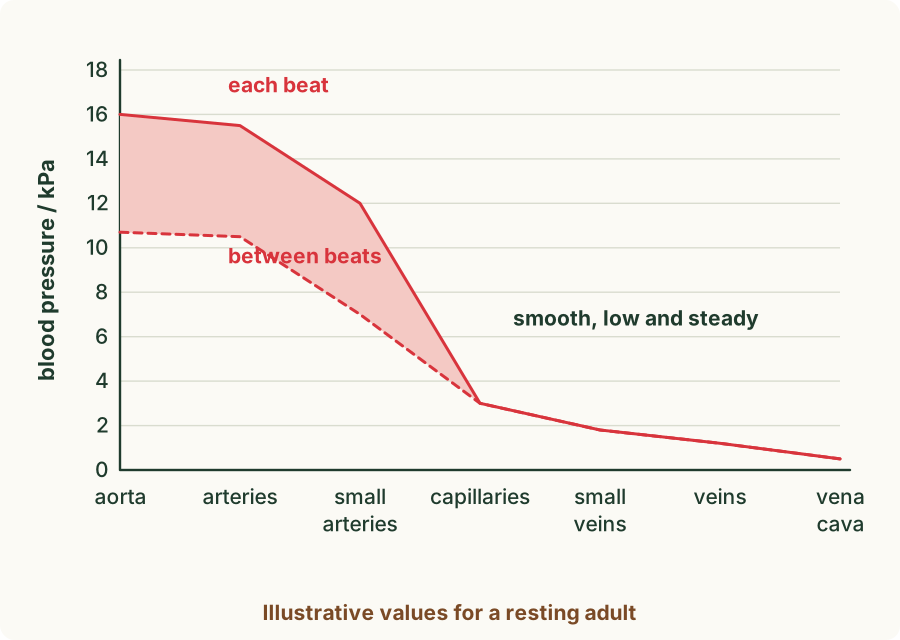
Nudge (only if you are stuck): Compare the pressure in the arteries with the pressure in the veins.
9. explain
Supplement. Explain how the structure of a vein is related to the low pressure of the blood it carries. Give two features.
(a) First feature and how it fits
(b) Second feature and how it fits
Nudge (only if you are stuck): What does low-pressure blood not need, and what does it need help with?
10. identify
A student looks at a slide of two vessels side by side and says: "The flattened one is the artery, because the blood pushed it out of shape." Do you agree? Explain how to decide which vessel is the artery.
Nudge (only if you are stuck): What on the slide is good evidence, and what could come from the way the slide was made?
11. suggest
Supplement. The aorta has more elastic tissue in its wall than any other artery. Suggest why.
Nudge (only if you are stuck): The aorta is the first artery the blood enters from the left ventricle.
12. explain
Supplement. A soldier who stands still at attention for a long time on a hot day may faint, because too little blood comes back from the legs to the heart, so too little reaches the brain. Soldiers are taught to tighten and relax their leg muscles now and then while they stand. Explain how this helps the blood in the leg veins return to the heart.
Nudge (only if you are stuck): What happens to the veins between the leg muscles when the muscles contract?