Pupil sheet · Absorption
Where food is absorbed — questions
Name ______________________ Date ____________
Try every question before you use a nudge. Write in full sentences where you are asked to explain.
1. identify
The diagram shows the digestive system. Which letter shows the region where nutrients are absorbed?
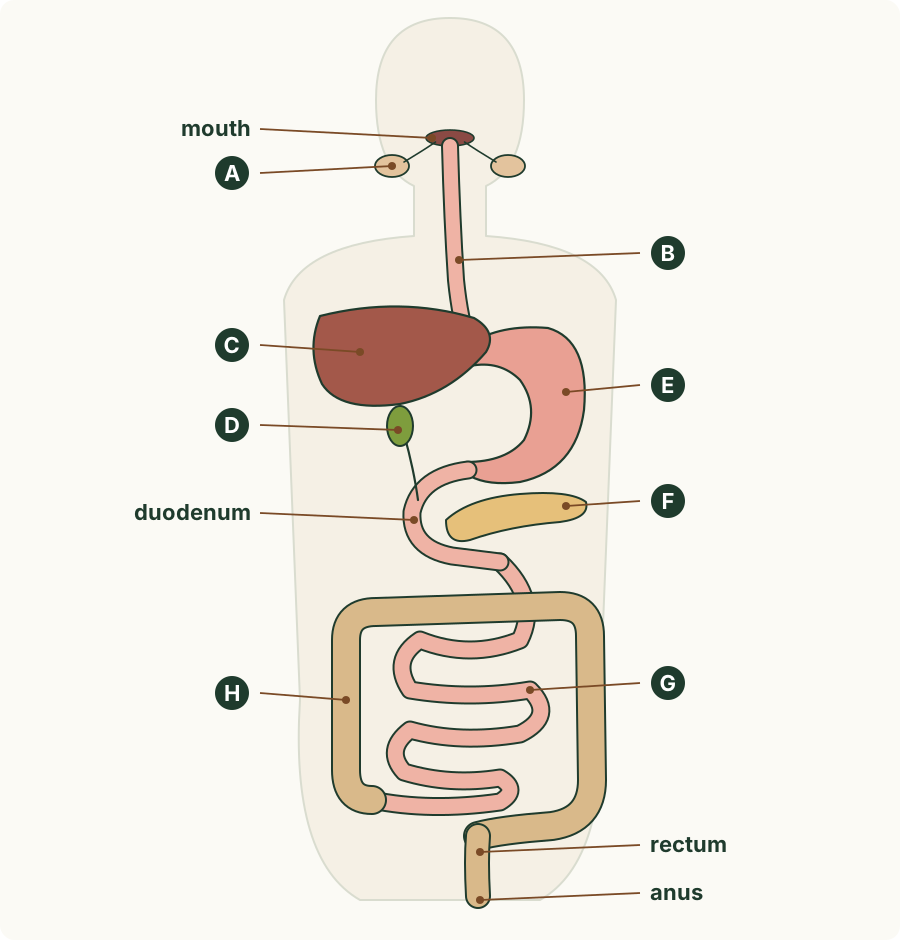
Circle one answer.
- G
- H
- E
- F
Nudge (only if you are stuck): Absorption comes after digestion. Follow the food from the mouth and ask where digestion is finished.
2. state
Complete the sentences about absorption.
Nutrients are absorbed in the … .
Absorption is the movement of nutrients from the intestines into the … .
Only small … molecules, such as glucose, can be absorbed.
Nudge (only if you are stuck): Absorption follows digestion. Think of where the small molecules go, and from which part of the gut.
3. state
Which statement about the absorption of water is correct?
Circle one answer.
- Most water is absorbed from the small intestine, but some is also absorbed from the colon.
- Most water is absorbed from the colon, but some is also absorbed from the small intestine.
- Most water is absorbed from the stomach, but some is also absorbed from the colon.
- All the water is absorbed from the small intestine, and none is absorbed from the colon.
Nudge (only if you are stuck): Two parts of the gut absorb water, but not equally.
4. identify
Four things happen to a salted meal of fish and rice, eaten with a glass of water. Match each one to digestion or absorption.
Write the number of the matching option.
- absorption
- digestion
- Protease breaks the protein in the fish into amino acids.: ______
- Mineral ions from the salt pass through the wall of the ileum into the blood.: ______
- Maltase breaks maltose from the rice into glucose.: ______
- Water from the drink moves from the colon into the blood.: ______
Nudge (only if you are stuck): Is a molecule being broken down, or moving through the wall of the intestine into the blood?
5. explain
Bread contains starch. Explain why the starch in bread must be digested before the body can absorb it.
Nudge (only if you are stuck): Which molecules can pass through the wall of the small intestine into the blood?
6. calculate
The table shows a person's water for one day. Calculate the volume of water absorbed from the small intestine.
| Water | Volume in one day / L |
|---|---|
| in food and drink | 2.8 |
| in digestive juices | 6.9 |
| absorbed from the colon | 1.2 |
| leaving in the faeces | 0.2 |
Water absorbed from the small intestine: ______________ unit ________
Nudge (only if you are stuck): All the water entering the gut is either absorbed or leaves in the faeces.
7. calculate
On one day 9.2 L of water enters a person's gut, and 7.8 L of it is absorbed from the small intestine. Calculate the percentage of the water that is absorbed from the small intestine. Give your answer to the nearest whole number.
Percentage absorbed from the small intestine: ______________ unit ________
Nudge (only if you are stuck): Percentage = part ÷ whole × 100.
8. suggest / explain
Some patients who cannot eat are fed through a thin tube. A solution of glucose and amino acids is passed along the tube straight into the small intestine. (a) Suggest why the solution is put into the small intestine. (b) Explain why the solution contains glucose and amino acids rather than starch and protein.
(a) Why the small intestine
(b) Why glucose and amino acids
Nudge (only if you are stuck): For (b): which molecules can pass straight through the wall into the blood without being digested first?
9. suggest / explain
In cholera, a toxin made by bacteria makes the small intestine absorb far less water than usual. The colon is not affected. (a) Suggest how the faeces change. (b) Explain why the healthy colon cannot stop the person losing a lot of water.
(a) How the faeces change
(b) Why the colon cannot make up for it
Nudge (only if you are stuck): Compare how much of the water each of the two parts normally absorbs.
10. suggest / explain
After an operation to remove the colon, the end of the ileum opens through the wall of the abdomen into a small bag. (a) Suggest how the contents of the bag differ from normal faeces. (b) Explain why the patient does not become short of glucose or amino acids after the operation.
(a) The contents of the bag
(b) Why glucose and amino acids are not short
Nudge (only if you are stuck): For (a): which part that absorbs water is missing? For (b): which part absorbs the nutrients?