Build a circuit · Physics
Lamp, resistor and switch
What it is for
A lamp lights, a resistor limits current, a switch breaks the circuit.
Mistake to avoid Using a lamp when you need a fixed resistance: its filament’s resistance rises as it heats, so its current–p.d. graph curves (Supplement).
Drawn in ink: the site's lab kit has no model of it yet, so the one at school may look a little different.
How it is asked
- Draw and recognise the circuit symbols for a lamp, a fixed resistor and a switch, open or closed.
- Say what each does: a resistor limits the current, a switch opens or closes the circuit, a lamp lights as current passes.
- Calculate resistance with R = V ÷ I. Explain the lamp’s curved current–p.d. graph: a hotter filament has a higher resistance (Supplement).
Exam-style question
A student connects a cell, a switch, an ammeter and a fixed resistor in series, with a voltmeter across the resistor.
- Draw the circuit diagram, using standard symbols.
- The voltmeter reads 3.0 V and the ammeter 0.20 A. Calculate the resistance.
- The resistor is replaced by a filament lamp. Why does V ÷ I rise as the p.d. is increased? (Supplement)
Show what a good answer says
- One series loop: cell, switch, ammeter and fixed resistor, in standard symbols; the voltmeter in parallel, across the resistor only.
- R = V ÷ I = 3.0 ÷ 0.20 = 15 Ω.
- The filament gets hotter as the current increases, and the resistance of the metal rises with its temperature.
Teaching points for checking your own answer, not official Cambridge marks.
More in “Build a circuit”
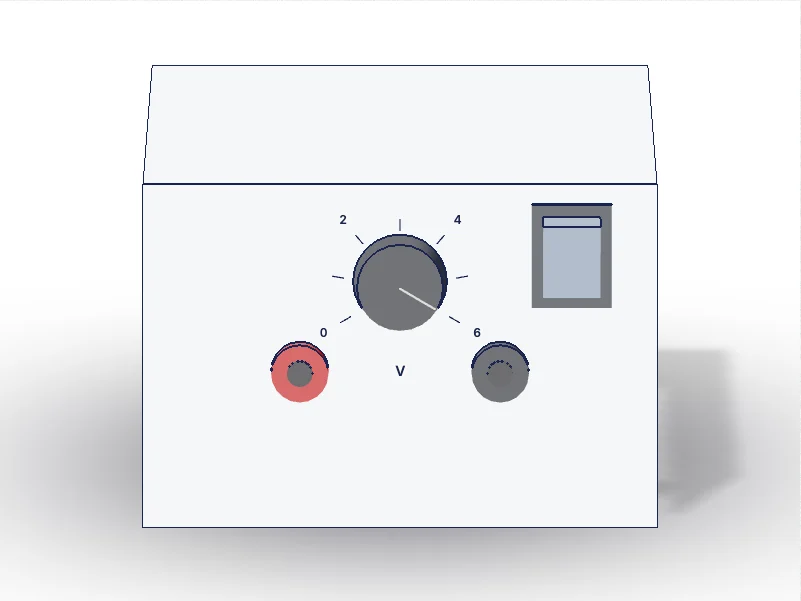 Cell and power supplyDrives current round a circuit; most dry cells give 1.5 V: check the label.Physics
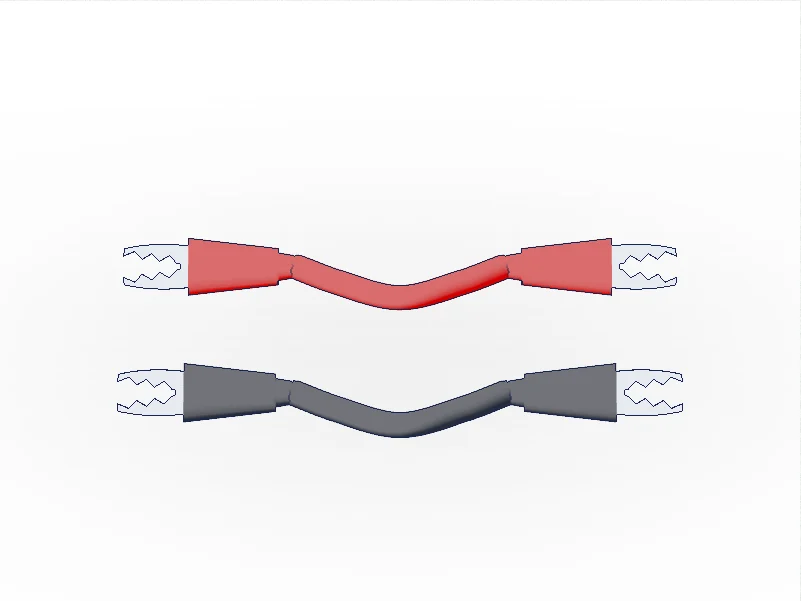 Leads and crocodile clipsJoin the parts of a circuit; crocodile clips grip wires and terminals.Physics
- Thermistor and LDRSensors: a thermistor’s resistance falls when hot, an LDR’s in light.Physics
- DiodeLets current flow one way only; it can turn a.c. into d.c.Physics