Pupil sheet · Refraction and total internal reflection
Refraction of light — questions
Name ______________________ Date ____________
Try every question before you use a nudge. Write in full sentences where you are asked to explain.
1. identify
The diagram shows a ray of light passing from air into glass. Match each numbered line to what it is.
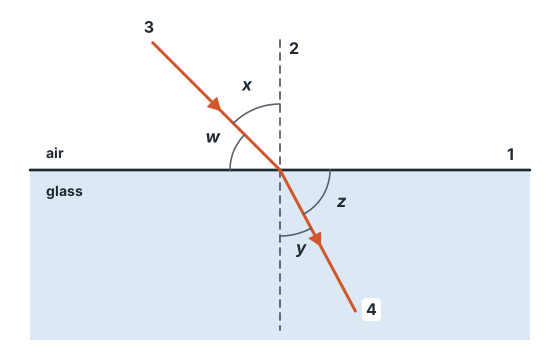
Write the number of the matching option.
- The reflected ray
- The incident ray
- The refracted ray
- The normal
- The boundary
- Line 1: ______
- Line 2: ______
- Line 3: ______
- Line 4: ______
Nudge (only if you are stuck): Which lines carry arrows, and which line is only a construction line? The arrows show which way the light travels. One option is not used.
2. identify
The same diagram marks four angles, w, x, y and z. Which of them is the angle of refraction?
Circle one answer.
- w
- z
- y
- x
Nudge (only if you are stuck): Find the refracted ray first. Which line are the angles in a ray diagram measured from?
3. calculate
A ray of light in air meets the flat surface of a glass block at 22° to the surface. Inside the glass, the refracted ray is at 51° to the surface. Calculate (a) the angle of incidence and (b) the angle of refraction.
(a) Angle of incidence (°): ______________ unit ________
(b) Angle of refraction (°): ______________ unit ________
Nudge (only if you are stuck): Both angles are measured from the normal, which is at 90° to the surface.
4. complete
Light travels more slowly in glass than in water. Complete the sentences. A ray of light that passes at an angle from water into glass bends ____ (1) the normal. A ray that passes at an angle from glass into water bends ____ (2) the normal. A ray that meets the boundary along the normal ____ (3) change direction, but its speed ____ (4).
Gap 1
Gap 2
Gap 3
Gap 4
Nudge (only if you are stuck): Which of the two is the slower medium? At each boundary, does the light slow down or speed up?
5. deduce
A ray of light passes from transparent material X into transparent material Y. The angle of incidence is 38° and the angle of refraction is 53°. Which row is correct?
| Row | Light travels faster in | At the boundary, the ray bends |
|---|---|---|
| A | X | towards the normal |
| B | X | away from the normal |
| C | Y | towards the normal |
| D | Y | away from the normal |
Circle one answer.
- A
- B
- C
- D
Nudge (only if you are stuck): Is the ray closer to the normal before or after the boundary? What does that tell you about the speed?
6. determine / describe
A ray of light enters one side of a rectangular glass block with an angle of incidence of 54°. The angle of refraction is 33°. The ray crosses the block and leaves through the opposite side, which is parallel to the first. (a) Determine the angle of incidence of the ray inside the glass at the opposite side. (b) Determine the angle between the ray that leaves and the normal there. (c) Describe how the ray that leaves compares with the ray that went in.
(a) Angle of incidence at the opposite side (°): ______________ unit ________
(b) Angle in the air at the opposite side (°): ______________ unit ________
(c) The ray that leaves and the ray that went in
Nudge (only if you are stuck): The two sides are parallel: how are their normals arranged? At the second side, is the light going into the glass or out of it?
7. describe
Put the steps in order to find the path of a ray of light through a triangular glass prism on a sheet of paper.
Write the number of each step in order.
- Aim the ray box along a line drawn at a measured angle to that normal, so that the ray enters there.
- Take the prism away, join the crosses and continue the line back to the outline of the prism.
- Draw around the prism, and draw a normal to the first side at the point where the ray will enter.
- Join the entry point to the exit point, draw the normal at the exit point, and measure the angles.
- Mark the ray that leaves the second side of the prism with two crosses, well apart.
- Step 1: ______
- Step 2: ______
- Step 3: ______
- Step 4: ______
- Step 5: ______
Nudge (only if you are stuck): Which marks must be made while the prism is still on the paper? Which lines can be drawn only once it has been taken away?
8. describe / explain
A ray of light in air enters one side of a triangular glass prism, crosses the prism and leaves through a second side. (a) Describe how the ray changes direction at each of the two sides. (b) Explain why the ray that leaves is not parallel to the ray that went in, when the ray leaving a rectangular block is.
(a) At the two sides
(b) Why not parallel
Nudge (only if you are stuck): At each side, draw the normal and ask whether the light is slowing down or speeding up. Then compare the directions of the two sides.
9. calculate
Supplement. Light travels at 3.00 × 10⁸ m/s in air and at 2.29 × 10⁸ m/s in ice. Calculate the refractive index of ice. Give your answer to 3 significant figures.
Refractive index of ice: ______________ unit ________
Nudge (only if you are stuck): Which speed goes on top, so that the refractive index of a slower medium is bigger than 1?
10. calculate
Supplement. Water waves in a harbour travel at 0.42 m/s where the water is deep, and at 0.30 m/s over a shallow sandbank. Calculate the refractive index for the waves passing from the deep water onto the sandbank.
Refractive index, deep water to the sandbank: ______________ unit ________
Nudge (only if you are stuck): For light going into glass, which speed goes on top? Which region plays the part of the air here?
11. calculate
Supplement. A dense flint glass used in camera lenses has a refractive index of 1.65. Light travels at 3.0 × 10⁸ m/s in air. Calculate the speed of light in this glass.
Speed of light in the glass: ______________ unit ________
Nudge (only if you are stuck): Rearrange the speed form of the refractive index so that the speed in the glass is on its own.
12. calculate
Supplement. A ray of light passes from air into a clear cooking oil. The angle of incidence is 56° and the angle of refraction is 34°. Calculate the refractive index of the oil.
Refractive index of the oil: ______________ unit ________
Nudge (only if you are stuck): Which angle is in the air? Use the sines of the angles, not the angles themselves.
13. calculate
Supplement. A glass has a refractive index of 1.55. A ray of light in air meets the glass with an angle of incidence of 70°. Calculate the angle of refraction.
Angle of refraction (°): ______________ unit ________
Nudge (only if you are stuck): Which angle is unknown? Can you divide an angle by n, or only its sine?
14. identify / calculate
Supplement. A pupil traces rays through a rectangular block of clear plastic on paper. At the first side of the block she measures four pairs of angles, shown in the table. (a) One reading is anomalous. Identify it: give its angle of incidence. (b) Calculate the refractive index of the plastic from the other three readings. Give your answer to 2 decimal places.
| Angle of incidence, i | Angle of refraction, r |
|---|---|
| 30° | 20° |
| 45° | 28° |
| 55° | 40° |
| 70° | 39° |
(a) Angle of incidence of the anomalous reading (°): ______________ unit ________
(b) Refractive index of the plastic, to 2 decimal places: ______________ unit ________
Nudge (only if you are stuck): In a good set of readings from one material, which quantity stays almost the same from row to row?
15. state / explain / calculate
A coin lies at the bottom of an empty mug. You look over the rim so that the coin is just hidden. Without moving your head, a friend fills the mug with water, and the coin comes into view. (a) Light from the coin leaves the water at the surface. State whether it bends towards or away from the normal. (b) Explain why you can now see the coin. (c) Supplement. The ray that reaches your eye leaves the water at 52° to the normal. The refractive index of water is 1.33. Calculate the angle between this ray and the normal in the water.
(c) Supplement: Angle to the normal in the water (°): ______________ unit ________
(a) Towards or away from the normal, and (b) why you can now see the coin
Nudge (only if you are stuck): Draw the ray from the coin to the surface and on to your eye. Does light speed up or slow down as it leaves the water?