Pupil sheet · Magnets and magnetic fields
Poles and magnetic fields — questions
Name ______________________ Date ____________
Try every question before you use a nudge. Write in full sentences where you are asked to explain.
1. identify
A pupil brings the ends of two bar magnets close together four times and records the force between them. Which row of the table is correct?
| Row | End of the first magnet | End of the second magnet | Force between them |
|---|---|---|---|
| A | N pole | N pole | attraction |
| B | N pole | S pole | repulsion |
| C | S pole | S pole | repulsion |
| D | S pole | N pole | no force |
Circle one answer.
- A
- B
- C
- D
Nudge (only if you are stuck): In each row, are the two facing ends the same kind of pole or different kinds? Then use the rule for each.
2. identify
Three ring magnets are slipped onto an upright pencil. They float one above the other without touching. The top face of the bottom magnet is an N pole. Identify the pole on the bottom face of the middle magnet.
Circle one answer.
- S pole
- It is not a pole, because poles are only at the ends of bar magnets
- It could be either pole
- N pole
Nudge (only if you are stuck): The middle magnet floats above the bottom one. Is the bottom magnet pushing it or pulling it?
3. identify
Which statement describes a magnetic field?
Circle one answer.
- A region in which iron filings can be seen
- The set of lines drawn round a magnet with a compass
- The space inside a magnet between its N and S poles
- A region in which a magnetic pole experiences a force
Nudge (only if you are stuck): Think about what a compass detects at a point near a magnet, even where no line has been drawn.
4. identify
A plotting compass is placed at point X near a bar magnet. The north-seeking end of its needle points towards the top of the page. What is the direction of the magnetic field at X?
Circle one answer.
- Towards the nearer pole of the magnet
- Towards the bottom of the page
- It has no direction: a field has only a strength
- Towards the top of the page
Nudge (only if you are stuck): The direction of a field is the direction of the force on an N pole. Which end of the needle is an N pole?
5. identify
The figure shows four drawings, A to D, of the magnetic field lines round a bar magnet. Identify the drawing that shows the pattern and direction of the field correctly.
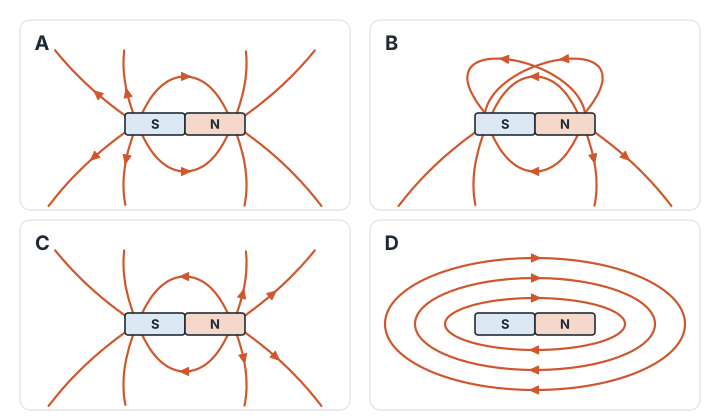
Circle one answer.
- Drawing A
- Drawing B
- Drawing C
- Drawing D
Nudge (only if you are stuck): Check three things in each drawing: where the lines start and end, which way the arrows point, and whether any lines cross.
6. identify
The figure shows the field lines round a bar magnet with its N pole on the left, and four points, P, Q, R and T. A plotting compass is placed at each point in turn. Match each point to the way the north-seeking end of the needle points.
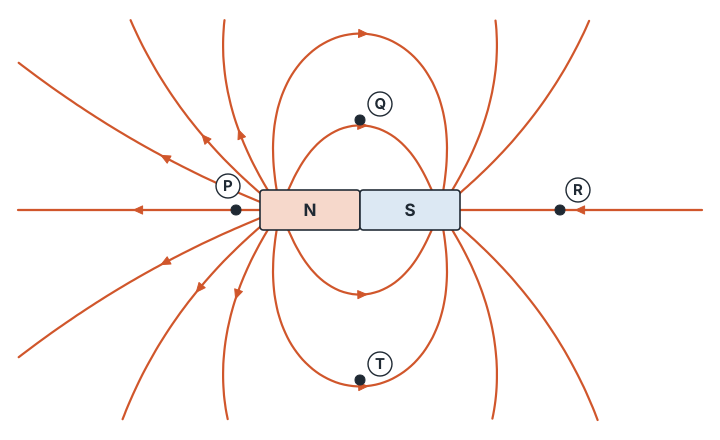
Write the number of the matching option.
- To the right
- Up the page
- Down the page
- To the left
- P: ______
- Q: ______
- R: ______
- T: ______
Nudge (only if you are stuck): Outside a magnet the field runs from N to S. Follow the line through each point.
7. describe
A pupil plots the magnetic field lines round a bar magnet with a plotting compass. Put the steps of the method in order.
Write the number of each step in order.
- Move the compass so that the south end of the needle is over that dot, and mark a new dot at the north end.
- Join the dots with a smooth curve and draw an arrow on it pointing from N to S.
- Repeat until the line reaches the S pole or the edge of the paper.
- Put the compass near the N pole and mark a dot at the north-seeking end of the needle.
- Draw round the magnet on a sheet of paper and mark its N and S ends.
- Step 1: ______
- Step 2: ______
- Step 3: ______
- Step 4: ______
- Step 5: ______
Nudge (only if you are stuck): Each new dot is found from the one before. What must be on the paper before the first dot?
8. identify
A pupil plots a field line starting near the N pole of a bar magnet. At each step she moves the compass so that the north-seeking end of the needle is over the last dot, then marks the new dot at the south end of the needle. Her dots run back into the N pole instead of curving round to the S pole. Identify the change that would correct her method.
Circle one answer.
- Put the south end of the needle over the last dot and mark the new dot at the north end.
- Move the magnet a little after each dot instead of moving the compass.
- Use a larger compass so that the dots are further apart.
- Tap the paper after each step so that the needle can turn freely.
Nudge (only if you are stuck): Which way along the line does the north-seeking end point? Which end of the needle should lead the way?
9. explain / describe
A pupil sprinkles iron filings on a card over a bar magnet and taps the card. Near the magnet the filings form curved lines. About 15 cm away they stay scattered at random. (a) Explain why the filings far from the magnet do not line up. (b) The pupil wants to add arrows to the pattern. Describe how she can find the direction of the field at a point on the card.
(a) Why the filings far away stay scattered
(b) Finding the direction
Nudge (only if you are stuck): How does the field change as you go further from the magnet? What is needed to turn a filing that rubs on the card?
10. calculate / describe
Supplement. Two identical bar magnets lie on a straight line with their S poles facing each other, 12.0 cm apart. Leave out the Earth’s field. (a) Calculate the distance from each S pole to the neutral point. Give your answer to 2 significant figures. (b) A compass is placed at the neutral point. Describe what its needle does.
(a) Distance from each S pole: ______________ unit ________
(b) What the compass needle does
Nudge (only if you are stuck): The magnets are identical. Where are their two fields equally strong and opposite?
11. explain
Supplement. Two bar magnets lie end to end on a bench with the N pole of one facing the S pole of the other, 3 cm apart. Explain, in terms of their magnetic fields, why the magnets attract.
What each magnet is in
Why each is pulled
What the field lines show
Nudge (only if you are stuck): Each magnet is in the field of the other. What does a field do to a pole placed in it?
12. identify
Supplement. Which statement about a drawing of the magnetic field lines round one bar magnet is correct?
Circle one answer.
- The field is strongest where the lines are closest together.
- The field is strongest beside the middle of the magnet, halfway between the poles.
- The field has the same strength at every point along one line.
- The field is strongest where the lines are furthest apart.
Nudge (only if you are stuck): Where on the drawing are the lines crowded together, and where does the magnet pull hardest?
13. identify / explain
Supplement. The figure shows the field lines round a bar magnet and four points, P, Q, R and T. Identify the point where the magnetic field is strongest, and give the reason.
Circle one answer.
- P
- Q
- R
- T
Your reason
Nudge (only if you are stuck): What does the spacing of field lines show?
14. identify
The figure shows the field lines between two magnets whose facing ends, X and Y, are not labelled. Which row of the table identifies the two poles and the force between the magnets?
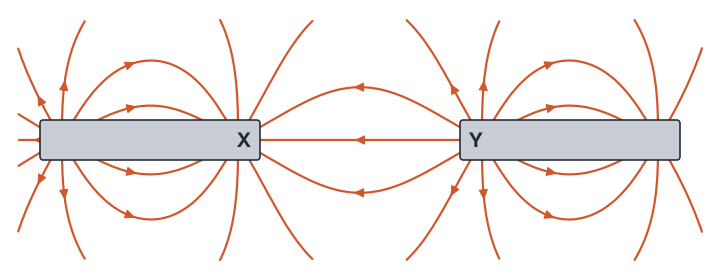
| Row | Pole at X | Pole at Y | Force between the magnets |
|---|---|---|---|
| A | N pole | S pole | attraction |
| B | S pole | N pole | attraction |
| C | N pole | N pole | repulsion |
| D | S pole | S pole | repulsion |
Circle one answer.
- A
- B
- C
- D
Nudge (only if you are stuck): Which way do field lines point outside a magnet? Do these lines join the two ends or turn away from the gap?
15. identify / explain
A hiker finds an old bar magnet whose ends are not labelled. She puts her compass just beyond one end, E, on the line through the middle of the magnet. The north-seeking end of the needle points towards E. (a) Identify the pole at E. (b) Explain how you know.
Circle one answer.
- An S pole
- It could be either pole
- An N pole
- Neither: the needle points along the magnet, not at a pole
(b) How you know
Nudge (only if you are stuck): The north-seeking end of a compass needle is itself a pole. Which kind of pole is it, and what does it do near an unlike pole?
16. explain / describe
Supplement. A pupil draws six field lines round a bar magnet. She says: “Halfway between two of my lines there is no magnetic field, because no line passes there.” (a) Explain why she is wrong. (b) Describe how her drawing shows where the field is strongest.
(a) Why she is wrong
(b) Where the field is strongest
Nudge (only if you are stuck): Would a compass placed between two of her lines turn?
17. explain
Supplement. Two plotting compasses are placed next to each other on a table, almost touching, far from any magnet. Their needles no longer point north. They turn until they lie in one line, the north-seeking end of one needle next to the south end of the other. Explain this, in terms of magnetic fields.
Whose field each needle is in
Why they line up with unlike poles together
Nudge (only if you are stuck): Each needle is a small magnet. Whose field is each needle in, and which field is stronger so close to it?