Pupil sheet · Echoes and ultrasound
Ultrasound and sonar — questions
Name ______________________ Date ____________
Try every question before you use a nudge. Write in full sentences where you are asked to explain.
1. identify
Match each sound to “Audible to humans” or “Ultrasound”.
Write the number of the matching option.
- Ultrasound
- Audible to humans
- A 12 kHz tone: ______
- A 25 000 Hz cleaning bath: ______
- A 0.5 MHz test probe: ______
- A 19 000 Hz whistle: ______
Nudge (only if you are stuck): Write each frequency in hertz first, then compare it with 20 000 Hz.
2. calculate
Calculate each frequency in the unit given. (a) 45 kHz in Hz. (b) 2.5 MHz in Hz. (c) 30 000 Hz in kHz.
(a) 45 kHz: ______________ unit ________
(b) 2.5 MHz: ______________ unit ________
(c) 30 000 Hz: ______________ unit ________
Nudge (only if you are stuck): k means thousand and M means million.
3. identify
Which statement about ultrasound is correct?
Circle one answer.
- It is sound with a frequency higher than 20 kHz.
- It travels faster than audible sound in the same medium.
- It is sound that is too loud for humans to hear.
- It is a wave that can travel through a vacuum.
Nudge (only if you are stuck): Check each statement against what every sound wave needs and what decides its speed.
4. explain
A dog trainer blows a whistle at 23 kHz. The dog turns round, but the trainer hears nothing. (a) Explain why the trainer hears nothing although the whistle makes a sound. (b) An electric buzzer that vibrates at the same 23 kHz is hung on thin threads inside a sealed glass jar, and all the air is pumped out of the jar. Explain whether the dog outside the jar would hear it.
(a) Why the trainer hears nothing
(b) In the empty jar
Nudge (only if you are stuck): Compare 23 kHz with the top of the human range. Then think about what every sound needs in order to travel.
5. calculate
Supplement. A ship’s sonar receives the echo from the seabed 0.36 s after sending a pulse. Sound travels through sea water at 1500 m/s. Calculate the depth of the sea.
Depth: ______________ unit ________
Nudge (only if you are stuck): Find the path of the pulse first. Which part of it is the depth?
6. calculate
Supplement. A harbour is 45 m deep. Sound travels through its water at 1500 m/s. Calculate how long after a sonar pulse is sent its echo from the harbour floor is received.
Time until the echo is received: ______________ unit ________
Nudge (only if you are stuck): How far does the pulse travel before its echo arrives back?
7. calculate / explain
Supplement. A fishing boat’s sonar sends one pulse and receives two echoes, at 0.050 s and at 0.120 s. One comes from a shoal of fish and one from the seabed. Sound travels through the sea water at 1500 m/s. (a) Calculate the depth of the shoal. (b) Calculate the depth of the seabed. (c) Explain how you knew which echo comes from the fish.
(a) Depth of the shoal: ______________ unit ________
(b) Depth of the seabed: ______________ unit ________
(c) How you knew which echo is from the fish
Nudge (only if you are stuck): Which reflects the pulse first: the fish or the seabed below them?
8. calculate / explain
Supplement. A technician tests a steel bar with an ultrasonic probe. The figure shows the flaw detector screen. Ultrasound travels through steel at 6000 m/s. One echo comes from the far side of the bar (the back wall) and one from a crack inside it. (a) Calculate the thickness of the bar in millimetres. (b) Calculate the depth of the crack below the probe in millimetres. (c) Explain which peak, P or Q, comes from the crack.
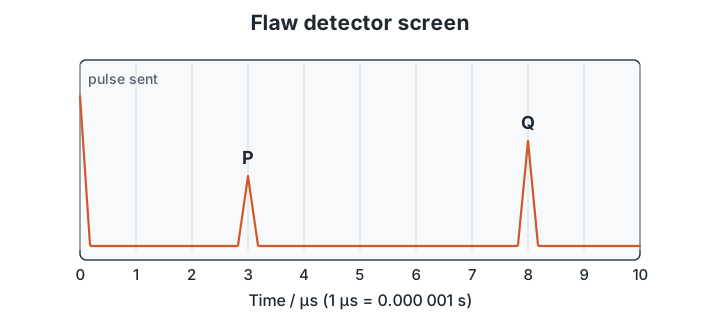
(a) Thickness of the bar: ______________ unit ________
(b) Depth of the crack: ______________ unit ________
(c) Which peak is the crack, and why
Nudge (only if you are stuck): Which surface is farthest from the probe? Change µs to s before you multiply.
9. explain / state
Supplement. A clinician scans a patient’s liver with ultrasound. (a) Explain why gel is spread between the probe and the skin. (b) State where in the body the pulses are reflected. (c) Explain why ultrasound, not X-rays, is chosen for scanning an unborn baby.
(a) Why gel
(b) Where the pulses reflect
(c) Why ultrasound, not X-rays
Nudge (only if you are stuck): Think about an air gap at the skin, the boundaries inside the body, and which radiation can damage cells.
10. explain / calculate
Supplement. A bat sends out a call at 45 kHz and hears the echo from a moth 0.020 s later. The speed of sound in air is 340 m/s. (a) Explain how you can tell that the call is ultrasound. (b) Calculate the distance from the bat to the moth.
(b) Distance to the moth: ______________ unit ________
(a) How you can tell it is ultrasound
Nudge (only if you are stuck): Which medium does the call travel through? Compare its frequency with 20 kHz.
11. calculate
Supplement. A survey ship stops over a point where the chart gives the depth as 82 m. Its sonar receives echoes from the seabed 0.108 s after each pulse. Calculate the speed of sound in this sea water. Give your answer to 3 significant figures.
Speed of sound in the sea water: ______________ unit ________
Nudge (only if you are stuck): Which distance does the pulse cover in 0.108 s?