Pupil sheet · Conduction and convection
Convection — questions
Name ______________________ Date ____________
Try every question before you use a nudge. Write in full sentences where you are asked to explain.
1. identify
Which row shows correctly where thermal energy can be transferred by convection?
| Row | In a solid | In a liquid | In a gas |
|---|---|---|---|
| A | yes | yes | yes |
| B | no | yes | no |
| C | no | yes | yes |
| D | no | no | yes |
Circle one answer.
- A
- B
- C
- D
Nudge (only if you are stuck): Think about what must move when energy travels by convection.
2. describe
Put these steps in order to explain how a convection current forms in water heated at the bottom.
Write the number of each step in order.
- The less dense water rises, pushed up by the denser water around it
- Cooler, denser water sinks to take its place and is heated in turn
- The water at the bottom is heated
- Its density falls
- Its particles move faster and spread out, so the water expands
- First: ______
- Second: ______
- Third: ______
- Fourth: ______
- Last: ______
Nudge (only if you are stuck): Start with the heating, and end with the water that keeps the current going.
3. explain
The burner of a hot-air balloon heats the air inside the balloon, and the balloon rises. Which statement explains why?
Circle one answer.
- Each air particle gets lighter when it is heated, so the air floats.
- The warmed air expands, so it is less dense than the cooler air outside.
- The heat rises, and it carries the balloon and the air inside with it.
- The flame from the burner pushes upwards on the top of the balloon.
Nudge (only if you are stuck): What happens to the volume of air when it is heated, and so to its density?
4. calculate
Air in a room at 15 °C has a density of 1.23 kg/m³. A radiator warms 2.40 m³ of this air, and it expands to 2.59 m³. (a) Calculate the mass of the air. (b) Calculate the density of the warm air. (c) Later the same air is warmed further, until its density is 1.08 kg/m³. Calculate its volume now. Give each answer to 3 significant figures.
(a) Mass of the air: ______________ unit ________
(b) Density of the warm air: ______________ unit ________
(c) Volume of the air: ______________ unit ________
Nudge (only if you are stuck): Which of mass, volume and density stays the same when the air is warmed?
5. predict
The diagram shows a glass tank of water. An electric heater lies on the bottom at D, and a crystal of purple dye lies on the bottom at C, in the far corner. The heater is switched on. Which path does the purple dye follow?
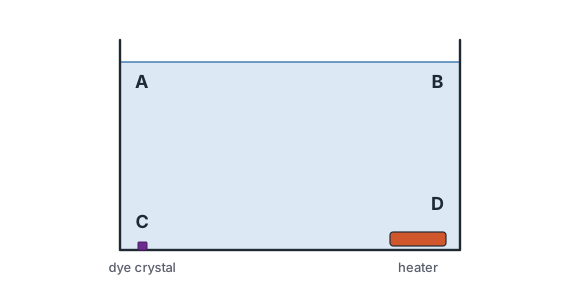
Circle one answer.
- Along the bottom from C to D, and it stays there by the heater
- Along the bottom from C to D, up to B, across to A, down to C
- It stays at C, because water conducts badly
- Up from C to A, across to B, down to D
Nudge (only if you are stuck): Where is the water warmed? Which water flows in to take the place of the water that rises?
6. describe / state / explain
Describe an experiment to show a convection current in water. (a) State the apparatus you use and where you put the heat. (b) Describe what you see. (c) Explain what you see in terms of density.
(a) Apparatus and heat
(b) What you see
(c) Explanation
Nudge (only if you are stuck): How can you make moving water visible? Where must the heat go so that the loop is easy to see?
7. predict
The diagram shows a smoke box with two chimneys, P and Q. A candle burns under chimney Q, and smouldering paper is held just above chimney Q. Predict where the smoke goes.
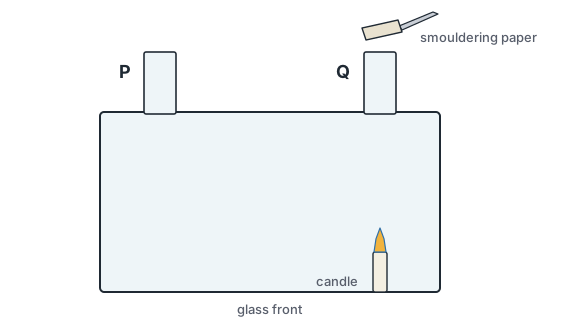
Circle one answer.
- Up and away above chimney Q
- Down chimney Q, across the box and up out of chimney P
- Straight down chimney Q to the candle
- Down chimney Q into the box, where it stays in a cloud
Nudge (only if you are stuck): Which way does the air move in chimney Q, the chimney above the candle?
8. explain
In many rooms the radiator is fixed under the window. On a winter night the window glass is very cold. Which statement explains why this is a good place for the radiator?
Circle one answer.
- Air cooled by the glass sinks, and the radiator warms it so it rises again.
- The radiator stops the cold from coming into the room through the glass.
- The cold glass draws warm air towards it, so the room heats evenly.
- Heat sinks from the radiator and warms the cold air near the floor.
Nudge (only if you are stuck): What happens to the density of the air that touches the cold glass?
9. identify
A camper heats a metal pot of water over a campfire. Match each transfer to the way the energy travels.
Write the number of the matching option.
- Convection
- Thermal radiation
- Conduction
- Energy passes through the metal bottom of the pot: ______
- Warm water rises from the bottom of the pot and cooler water sinks: ______
- Her face feels hot as she sits facing the fire: ______
- The pot's metal handle slowly gets warm along its length: ______
- Sparks are carried high above the fire: ______
Nudge (only if you are stuck): For each one, ask: does a material stay in place, does a fluid move, or is no material needed?
10. state / explain / predict
A chest freezer in a shop is open at the top, yet the food inside stays frozen. (a) State what happens to the density of the air cooled by the freezer walls. (b) Explain why very little of the cold air escapes from the open top. (c) An upright freezer has a door at the front. Predict what happens to the cold air when the door is opened, and explain why.
(a) Density of the cooled air
(b) The open chest
(c) The upright freezer
Nudge (only if you are stuck): What happens to the volume of air when it is cooled? Where does a denser fluid go?
11. state / explain
On a calm, sunny afternoon, a large car park of dark tarmac lies next to a grassy park. The tarmac becomes much hotter than the grass. (a) State which way the air moves near the ground between the park and the car park. (b) Explain why, in terms of density.
(a) Direction
(b) Explanation
Nudge (only if you are stuck): Which air is warmed? What does it do, and what fills its place?
12. explain / suggest
A hot water tank in a house is heated by an electric heater near the bottom of the tank. Hot water for the taps is taken from a pipe at the top. (a) Explain how the heater warms all the water in the tank. (b) Explain why the hot water pipe is at the top. (c) Suggest what would happen if the heater were fitted near the top of the tank instead.
(a) How all the water is heated
(b) Why the pipe is at the top
(c) A heater at the top
Nudge (only if you are stuck): Where does warmed water go, and what takes its place?