Pupil sheet · Physical and chemical changes
Same particles, or new ones? — questions
Name ______________________ Date ____________
Try every question before you use a nudge. Write in full sentences where you are asked to explain.
1. identify
Liquid nitrogen is poured into a dish. It boils away at room temperature and turns into nitrogen gas. What happens to the nitrogen molecules, N2?
Circle one answer.
- They join with oxygen to make a new gas
- They get bigger as they turn into a gas
- They break up into separate nitrogen atoms
- They stay N2 molecules but move far apart
Nudge (only if you are stuck): Is there any new kind of particle in the gas?
2. identify
Match each change to the kind of change it is.
Write the number of the matching option.
- Chemical change
- Physical change
- 1. A puddle drying up in the sun: ______
- 2. Bleach taking a red wine stain out of a cloth: ______
- 3. Instant coffee dissolving in hot water: ______
- 4. A copper roof slowly turning green: ______
- 5. Paper being cut into strips: ______
- 6. Fish going off and smelling bad: ______
Nudge (only if you are stuck): Is there a new substance at the end?
3. identify
The diagrams show three changes, P, Q and R, before and after. Which one shows a chemical change?
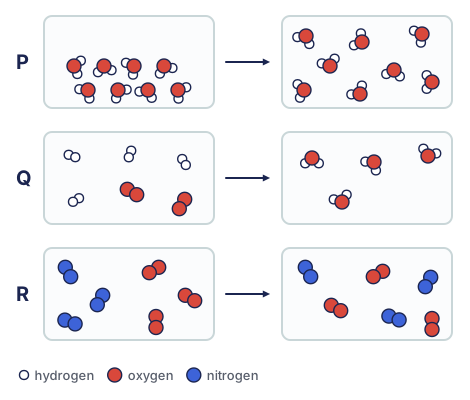
Circle one answer.
- R
- P
- Q
- P and R
Nudge (only if you are stuck): Is there any kind of particle after that was not there before?
4. explain / name / determine / describe
Look at the diagrams P, Q and R again. (a) Explain why R is a physical change, even though the particles end up mixed. (b) Name the new substance made in Q. (c) Determine the number of hydrogen atoms and the number of oxygen atoms before and after Q. Describe what you notice.
(a) Why R is physical
(b) The new substance in Q
(c) The atom count
Nudge (only if you are stuck): In (c), count every atom in each box.
5. identify
A purple crystal of potassium manganate(VII) is dropped into a beaker of water. Over an hour the crystal disappears from view, and the purple colour spreads through all the water. Which statement is correct?
Circle one answer.
- Chemical: the purple colour spreads through the water
- Chemical: the crystal has stopped existing
- Physical: the particles split into smaller atoms
- Physical: the same particles spread out in the water
Nudge (only if you are stuck): If you let all the water evaporate, what would be left?
6. explain
A little white ammonium chloride is heated at the bottom of a test tube. The solid at the hot end slowly disappears. A piece of damp red litmus paper at the mouth of the tube turns blue; ammonium chloride itself does not turn red litmus blue. Higher up, where the glass is cool, a white solid forms on the inside of the tube. A pupil says: "The white solid came back, so this is a physical change, like water boiling and condensing." Explain why the pupil is wrong.
Nudge (only if you are stuck): What does the litmus paper tell you about the gas in the hot tube?
7. identify
Which change is a chemical change, given with the right reason?
Circle one answer.
- Toasting a marshmallow: its crust is crisp and tastes burnt
- Fog forming over a lake: the clear air turns white
- Setting a jelly: it turns from a liquid into a solid
- Snapping chalk: there are now two pieces instead of one
Nudge (only if you are stuck): Which change leaves something at the end with properties that the start did not have?
8. identify / suggest / explain
Damp charcoal is lit in a barbecue. At first it hisses, and steam rises from it. Then it glows red for an hour and shrinks to a little grey ash. Charcoal is mainly carbon, and nothing drips out of the barbecue. (a) Identify the physical change that makes the steam. (b) Identify the chemical change, and suggest the name of the gas it makes. (c) Explain, using particles, why the charcoal gets smaller.
(a) The physical change
(b) The chemical change and its gas
(c) Why the charcoal gets smaller
Nudge (only if you are stuck): Where do the carbon atoms go while the charcoal glows?