Pupil sheet · Covalent molecules
Sharing electrons — questions
Name ______________________ Date ____________
Try every question before you use a nudge. Write in full sentences where you are asked to explain.
1. state
Which statement describes a covalent bond?
Circle one answer.
- A pair of electrons shared between two atoms
- An electron transferred from one atom to another
- A weak attraction between neighbouring molecules
- A strong attraction between oppositely charged ions
Nudge (only if you are stuck): Think of hydrogen and chlorine on the board: did either atom become an ion?
2. identify
Hydrogen gas is made of H2 molecules, and hydrogen iodide of HI molecules (an iodine atom has 7 outer electrons). Each molecule has one covalent bond. Which row is correct?
| Row | Electrons shared in H2 | Electrons each H atom counts in H2 | Lone pairs on the I atom in HI |
|---|---|---|---|
| A | 2 | 2 | 3 |
| B | 2 | 1 | 3 |
| C | 2 | 2 | 6 |
| D | 1 | 1 | 3 |
Circle one answer.
- A
- B
- C
- D
Nudge (only if you are stuck): How many electrons does each atom put into a shared pair? How many outer electrons does iodine keep?
3. deduce
Each of these elements forms a molecule with hydrogen in which every atom has a full outer shell. Match each element to the formula of that molecule.
Write the number of the matching option.
- SiH4
- PH3
- H6S
- HF
- H2S
- PH5
- Fluorine, 2,7: ______
- Sulfur, 2,8,6: ______
- Phosphorus, 2,8,5: ______
- Silicon, 2,8,4: ______
Nudge (only if you are stuck): Hydrogen makes one bond. How many electrons is each other atom short of a full outer shell?
4. determine / identify / describe
A pupil drew this dot-and-cross diagram of water. (a) Determine how many electrons the oxygen atom counts in this diagram. (b) Identify the mistake, and describe the correction.
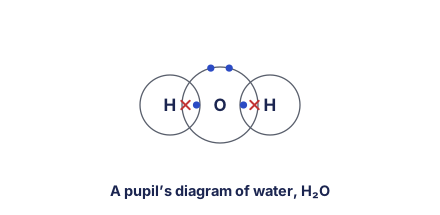
(a) Electrons oxygen counts in this diagram: ______________ unit ________
(b) The mistake and the correction
Nudge (only if you are stuck): Count oxygen’s electrons: every electron in its two overlaps and every electron on the rest of its shell.
5. determine
A chlorine atom is 2,8,7. In a chlorine molecule, Cl2, both atoms reach a full outer shell. Determine (a) the total number of outer-shell electrons in the molecule, (b) how many of them are shared and (c) the number of lone pairs in the whole molecule.
Outer-shell electrons in the molecule: ______________ unit ________
Shared electrons: ______________ unit ________
Lone pairs in the molecule: ______________ unit ________
Nudge (only if you are stuck): Add the outer electrons of both atoms first, counting each electron once.
6. determine / explain / state
Carbon is 2,4. A pupil describes a dot-and-cross diagram of methane, CH4: “The carbon shell overlaps four hydrogen shells. Each overlap holds one cross from carbon and one dot from hydrogen. Carbon also keeps one lone pair of crosses, like nitrogen in ammonia.” (a) Determine how many crosses this description gives the carbon atom. (b) Explain why the description is incorrect, and state how many lone pairs carbon has in methane.
(a) Crosses on carbon in the pupil’s description: ______________ unit ________
(b) Why the description is incorrect, and the lone pairs carbon has
Nudge (only if you are stuck): Each cross stands for one of carbon’s own outer electrons.
7. identify
Oxygen is 2,6 and fluorine is 2,7. In a molecule of oxygen difluoride, OF2, the oxygen atom is between the two fluorine atoms, and every atom has a full outer shell. The figure shows four dot-and-cross diagrams, outer shells only: dots for oxygen, crosses for fluorine. Which diagram is correct?
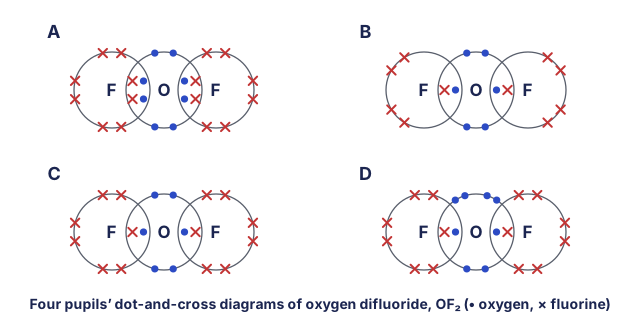
Circle one answer.
- A
- B
- C
- D
Nudge (only if you are stuck): Find how many electrons each atom needs, then count each atom in each diagram.
8. explain
Neon, 2,8, is a gas made of single atoms: neon atoms form no covalent bonds. Which statement explains why?
Circle one answer.
- Its outer shell is full, so it needs no more electrons
- It gives its outer electrons away to other atoms
- Its atoms are too small to share electrons
- It needs 8 more electrons, too many to share
Nudge (only if you are stuck): How many electrons does neon need to fill its outer shell?
9. determine / deduce
Supplement. A nitrogen atom is 2,5. A pupil’s dot-and-cross diagram of a nitrogen molecule, N2, shows two shared pairs between the atoms and one lone pair on each atom. Determine (a) how many electrons each nitrogen atom counts in the pupil’s diagram and (b) how many of each atom’s own 5 outer electrons the pupil drew. Deduce (c) the number of shared pairs in a correct N2 molecule.
(a) Electrons each nitrogen atom counts in the pupil’s diagram: ______________ unit ________
(b) Own outer electrons of each atom in the pupil’s diagram: ______________ unit ________
(c) Shared pairs in a correct N2 molecule: ______________ unit ________
Nudge (only if you are stuck): Each shared pair counts both its electrons for both atoms, but only one of the two is the atom’s own.
10. identify
Supplement. Carbon is 2,4 and sulfur is 2,8,6. In a carbon disulfide molecule, CS2, the carbon atom is between the two sulfur atoms, and every atom has a full outer shell. The figure shows four dot-and-cross diagrams, outer shells only: crosses for carbon, dots for sulfur. Which diagram is correct?
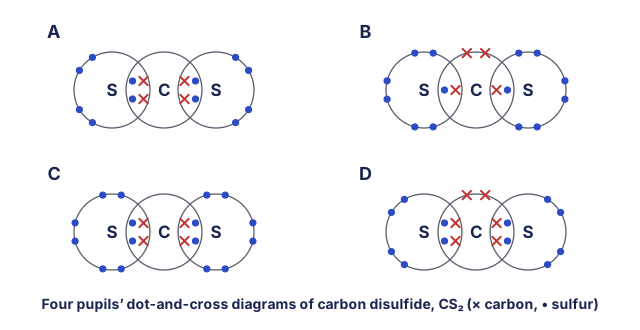
Circle one answer.
- A
- B
- C
- D
Nudge (only if you are stuck): Find how many electrons each atom needs, then count each atom in each diagram.
11. determine / deduce
Supplement. Ethene, C2H4, has two carbon atoms (2,4), each bonded to the other carbon atom and to two hydrogen atoms. A pupil’s diagram shows one shared pair between the carbon atoms and one shared pair between each carbon and each of its hydrogen atoms. Determine (a) how many electrons each carbon atom counts in its shared pairs in the pupil’s diagram. Deduce (b) how many shared pairs the carbon atoms must have between them and (c) the total number of shared pairs in a correct ethene molecule.
Electrons each carbon counts in the pupil’s diagram: ______________ unit ________
Shared pairs between the carbon atoms: ______________ unit ________
Shared pairs in a correct molecule: ______________ unit ________
Nudge (only if you are stuck): Count each carbon’s electrons as you go: it must reach 8.
12. determine
Supplement. In methanol, CH3OH, the carbon atom (2,4) is bonded to three hydrogen atoms and to the oxygen atom (2,6), and the oxygen atom is also bonded to a hydrogen atom. Determine (a) the number of shared pairs in the molecule, (b) the total number of outer-shell electrons from all six atoms and (c) the number of lone pairs in the molecule.
Shared pairs in the molecule: ______________ unit ________
Outer-shell electrons from all six atoms: ______________ unit ________
Lone pairs in the molecule: ______________ unit ________
Nudge (only if you are stuck): List every bond first. Then add each atom’s own outer electrons, once each.
13. deduce / describe / state
Phosphorus is 2,8,5 and chlorine is 2,8,7. (a) Phosphorus and chlorine form a molecule in which every atom has a full outer shell. Deduce its formula. (b) Describe its dot-and-cross diagram: the shared pairs, and the lone pairs on each atom. (c) State the noble gas configuration the atoms reach. (d) Supplement: in hydrazine, N2H4, the two nitrogen atoms (2,5) are bonded to each other, and each nitrogen atom is also bonded to two hydrogen atoms. Deduce the type of bond between the two nitrogen atoms, and the number of lone pairs on each nitrogen atom.
(a) The formula
(b) Shared pairs and lone pairs
(c) Noble gas configuration
(d) Supplement: hydrazine
Nudge (only if you are stuck): Phosphorus has as many outer electrons as nitrogen. For (d), count the pairs each nitrogen already shares with hydrogen.