Pupil sheet · Inside the atom
Electrons in shells — questions
Name ______________________ Date ____________
Try every question before you use a nudge. Write in full sentences where you are asked to explain.
1. identify
Match each atom to its electronic configuration. The proton number is in brackets.
Write the number of the matching option.
- 2,1
- 2,6
- 2,8,1
- 2,8,7
- 2,8,8,1
- 2,8,8,2
- Lithium (3): ______
- Oxygen (8): ______
- Sodium (11): ______
- Chlorine (17): ______
- Calcium (20): ______
Which configuration was left over, and which atom has it?
Nudge (only if you are stuck): The number of electrons in an atom is its proton number. Fill the first shell with 2, the next with up to 8, then up to 8.
2. state
Fill in the missing word or number in each sentence.
1. The first shell holds up to ___ electrons.
2. In Groups I to VII, the number of outer-shell electrons is the same as the ___ number.
3. The number of occupied shells is the same as the ___ number.
4. The noble gases in Group VIII have a ___ outer shell.
Nudge (only if you are stuck): Each sentence is part of the Key idea of this part.
3. identify
Phosphorus has proton number 15. Which is the electronic configuration of a phosphorus atom?
Circle one answer.
- 2,13
- 2,5,8
- 2,8,5
- 2,8,4,1
Use your answer to state the Group and the Period of phosphorus.
Nudge (only if you are stuck): 15 electrons: how many go in the first shell, how many in the second, and how many are left?
4. deduce
The diagram shows the electrons in an atom. Deduce (a) the proton number of the atom, (b) its Group number and (c) its Period number.
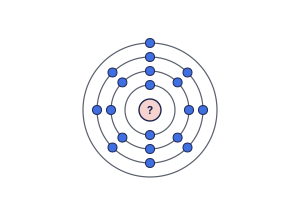
(a) Proton number: ______________ unit ________
(b) Group number, as a digit (1 for Group I): ______________ unit ________
(c) Period number: ______________ unit ________
Nudge (only if you are stuck): Count all the electrons for (a). Then use the outer shell and the number of shells.
5. state / explain
(a) Write the electronic configuration of a magnesium ion, Mg2+. Magnesium's proton number is 12. (b) Write the electronic configuration of a fluoride ion, F−. Fluorine's proton number is 9. (c) Kai says: “The two ions have the same configuration, so they must be the same element.” Explain why Kai is wrong.
(a) Configuration of Mg2+
(b) Configuration of F−
(c) Why Kai is wrong
Nudge (only if you are stuck): First find the number of electrons in each ion from the proton number and the charge.
6. deduce / suggest
(a) Element X is in Group VI and Period 3 of the Periodic Table. Deduce its electronic configuration and its proton number, and name it. (The elements with proton numbers 14 to 18 are silicon, phosphorus, sulfur, chlorine and argon.) (b) Lithium, sodium and potassium all react with water in a very similar way. Write the electronic configuration of each atom (proton numbers 3, 11 and 19) and suggest what they have in common that could explain this. (c) Helium’s electronic configuration is 2. State its Group and explain why it is not in Group II.
(a) Configuration, proton number and name of X
(b) The three configurations and what they have in common
(c) Helium’s Group, and why not Group II
Nudge (only if you are stuck): For (a), Period 3 means three shells, Group VI means 6 in the outer one. For (b), compare the last number of each configuration. For (c), think about how many electrons the first shell holds.